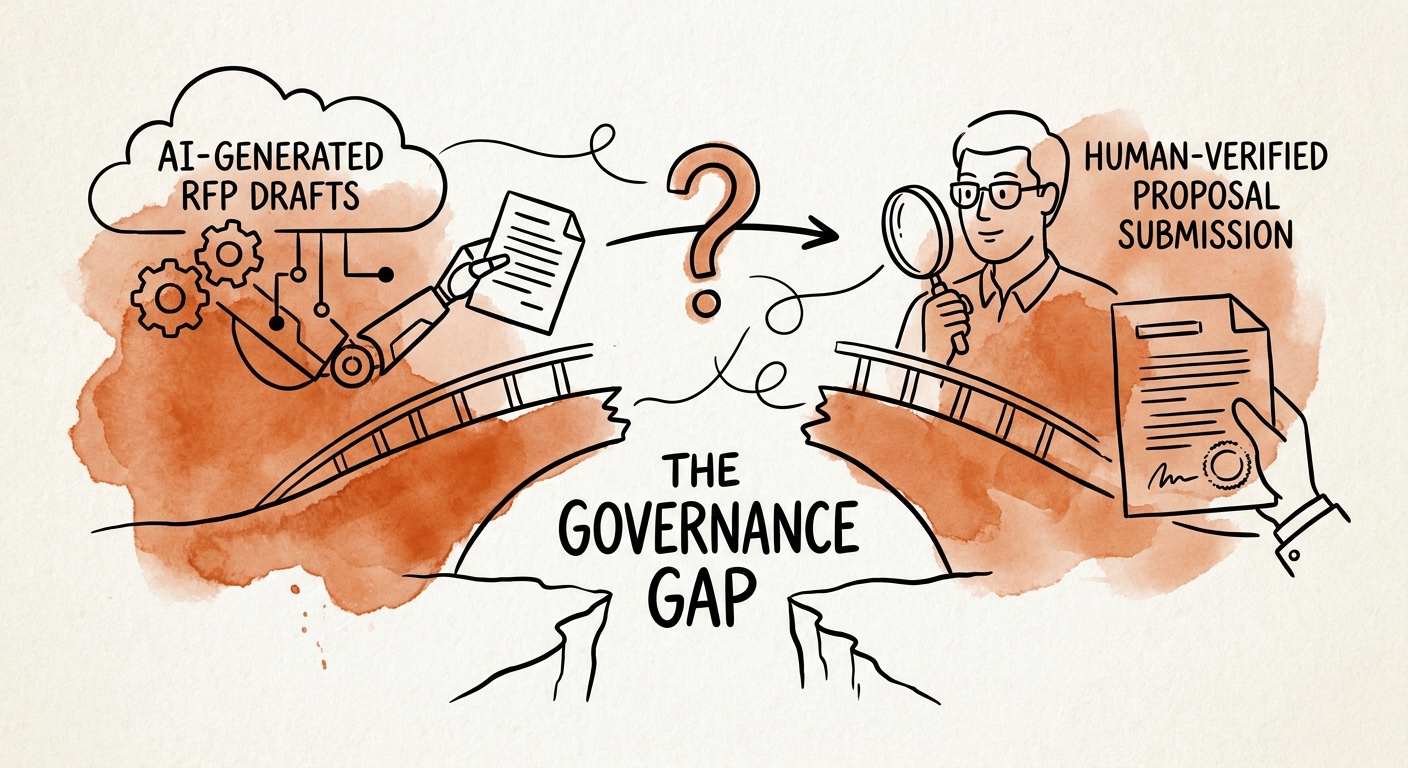
The question is never "can AI write this RFP." It's "which answer is it allowed to give."
Picture the security section of a 180-question enterprise RFP landing in your inbox on a Thursday with a Monday deadline. Question 47 asks about your data residency. Your assistant pulls a confident paragraph: "All customer data is stored in US-based AWS regions." That sentence was true in 2023. Then you opened a Frankfurt region for a European logo, and nobody updated the answer library. AI didn't lie. It faithfully retrieved a stale fact and stapled it to a document a procurement officer will treat as a representation of what you do.
That is the whole problem with RFP automation in one example, and it is why the framing of "can AI draft this faster" misses the point. RFP responses are not blog posts where a wrong sentence is an embarrassment. They are pre-contractual statements. A bad SOC 2 answer, an SLA you can't hit, a feature you described as "available today" that is actually on the roadmap — these surface during legal review or, worse, after you've won and someone holds you to the words. The output isn't content. It's exposure.
So the good use of AI here is narrow and powerful: retrieve the approved answer, summarize the requirement, and flag the questions you have no approved answer for. The Salesforce State of Sales read is blunt about this — AI-assisted selling only works on top of trusted account and process data; bolt it onto a messy answer library and you've automated the spread of your worst sentence. The unsafe use is letting the model compose commitments from old proposal decks and "reasonable assumptions." On an RFP, a reasonable-sounding assumption is how you accidentally agree to a 99.99% uptime SLA you architected for 99.9%.
Sort your answer library by who has to sign off — not by topic
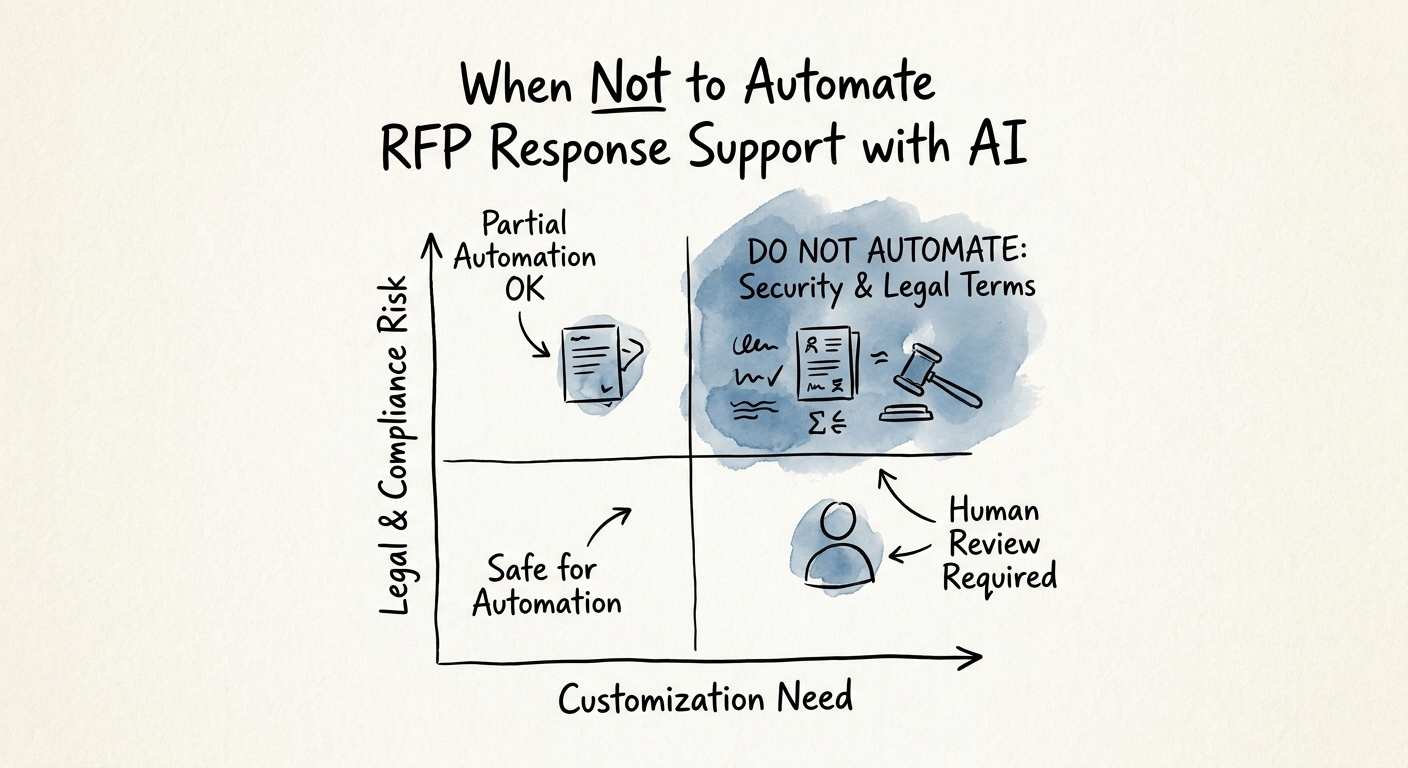
Most teams organize RFP content by section: security, pricing, implementation, references. That's a search taxonomy, not a governance one. The taxonomy that actually protects you sorts every answer by what kind of claim it is and who owns it, because that determines whether AI can serve it unsupervised. A green-light tier holds approved, current, factually-checkable answers — your headquarters address, your supported integrations, your published certifications. The model can pull these all day. A yellow tier holds anything with a shelf life or a number attached: pricing, capacity, SLAs, customer references that require permission to name. The model can suggest these, but a human owner releases them. A red tier holds claims that don't exist yet — the question you've never been asked — where AI's only legitimate job is to say "no approved answer, route to engineering."
The NIST AI Risk Management Framework gives the sequence cleanly: map the context, measure the risk, manage the controls, govern the changes. Applied to a security questionnaire, "map" means knowing which questions trigger legal review before a word leaves the building. "Govern" means that when you close the Frankfurt region — or open it — the data-residency answer flips state in one place, not in fourteen old proposals AI might cite from. An answer that can't be invalidated centrally is an answer that will eventually be wrong in a winning bid.
The PwC Responsible AI survey makes the point that responsible AI lives inside the workflow, not in a policy PDF. For RFPs that's concrete: the proposal owner assembles, the technical owner validates the capability claims, legal or compliance clears the questions that carry liability, and someone with commercial authority signs off on every number before it's submitted. Skip the technical-owner step and your AI will cheerfully describe a feature the way Sales wishes it worked. If you're running this through an enterprise assistant, the Microsoft 365 Copilot data protection architecture handles identity, permissions, and audit logging — useful, but understand its limit: it controls who can see what, not which answer is approved for this specific bid. Permissions are not approval. The tool will happily let an authorized user surface a yellow-tier number that nobody cleared.
Earn the right to automate: measure reuse before you scale it
Don't ask "should we automate RFPs." Ask "is our answer library trustworthy enough to automate yet," and answer it with numbers from the next five real bids. Track four things. Citation coverage: what fraction of AI-served answers trace back to a green-tier, dated source rather than a guess? Reviewer correction rate: how often does the technical or legal owner have to rewrite what the model proposed? A correction rate that won't fall below 30% means your library is the problem, not the model. Unsupported-claim flags: is the system actually routing the red-tier questions to humans, or quietly filling them? Cycle time on the boring half — the repeatable company-profile and integration questions that eat a sales engineer's afternoon.
The honest sequence is unglamorous. First, let AI shrink the search-and-assemble grind on green-tier answers — that alone can hand a two-person proposal team back the equivalent of a day per major bid. Then, only once your correction rate is low and your invalidation process is real, expand into the yellow tier with mandatory sign-off gates intact. Automating the response before the library and approval flow are stable doesn't make you faster. It makes you fast at submitting answers you'd take back if you'd read them.
If you want the structural piece first, the discipline of an approved-answer layer is the same one that powers any reliable retrieval system — start with the knowledge-systems AI path to build it, and the proposal drafting governance guide for the broader narrative-document version of this problem. Build the library that knows what's true before you let anything write in your name.