The Sunday night before the QBR
Picture the account manager at a 40-seat managed service provider, the night before a quarterly review with a client worth $9K MRR. The renewal is 60 days out. To prep, she opens five tabs: the PSA to pull ticket volume and SLA breaches, the CRM to remember what was promised at the last review, the RMM to see what changed in the client's environment, the contract to confirm the renewal date and seat count, and her own email to find the thread where the client complained about backup restore times. Two hours later she has a deck that is mostly accurate and entirely exhausting to assemble — and she still missed the three P1 tickets from March because they were closed under a different requester's name.
That is the actual job an account-research assistant has to do for an MSP. Not "summarize the account." Reconcile the scattered service record into a renewal briefing that an account manager can defend in the room. The pressure to do this faster is real — Census data on business AI adoption means your clients are increasingly running AI in their own shops and expect their MSP to be at least as sharp. But speed is not the point. Grounding is. A briefing point that doesn't trace back to a ticket, a contract line, or a CRM note is worse than no briefing, because it gives the AM false confidence in front of the buyer.
Build it around the systems of record, not the prompt
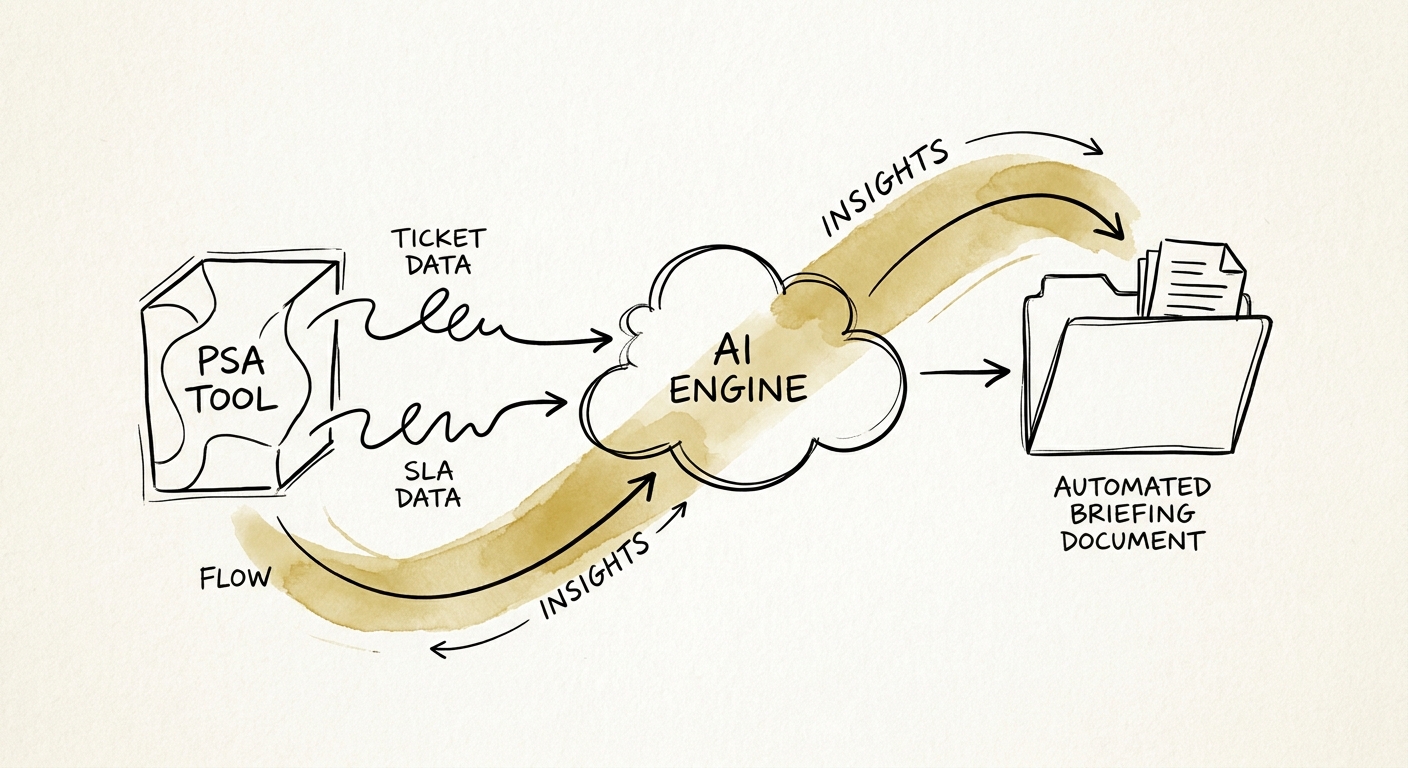
The design decision that separates a useful MSP account assistant from a glorified note-taker is the source hierarchy you wire in before you write a single prompt. For account research at an MSP, that order is concrete: PSA for service history and SLA performance, ticketing for the unresolved patterns (recurring tickets on the same asset, reopened incidents, after-hours volume), RMM and asset inventory for environment drift since the last review, CRM for what was committed relationship-wise, and the contract for renewal timing and seat counts. Each briefing line gets tagged with which system it came from and how fresh that record is. A ticket closed two days ago and a CRM note from fourteen months ago should never carry the same visual weight.
The risk here is not the model writing strange sentences. It is two MSP-specific failure modes. First, cross-tenant bleed: in a multi-tenant PSA, the assistant must enforce the same client boundary the tech sees, or it will quietly pull Client B's ticket into Client A's brief. CISA's AI data-security guidance reads, for an MSP, as a hard tenant-isolation requirement, not a nice-to-have. Second, confident thinness: NIST's AI Risk Management Framework is useful precisely because it forces you to treat "the brief sounds authoritative but is built on two stale notes" as a named risk you log and monitor, not a surprise. The fix is structural — show confidence by source type, mark stale records, and route anything touching pricing, contract language, or a security incident back to the account owner before it reaches the client. The San Francisco Fed's small-business AI research flags trust and skill gaps that hit owner-led MSPs fast; the antidote is letting the AM see exactly where each line came from so they can challenge it.
Pilot one renewal cohort, then decide
Don't roll this across the whole book. Take the next cohort of accounts up for renewal in one quarter — say eight clients — and run the AI brief alongside the AM's normal manual prep. Then compare hard numbers, not vibes: hours spent assembling each brief, renewal risks the AM surfaced before the meeting versus after, stale client facts the system flagged and removed, expansion ideas the account owner actually accepted, and service issues escalated before they became a commercial surprise at the table. If the brief only shaves drafting time, you bought a convenience tool. If the AM consistently catches a renewal risk she would have missed — the silent ticket pattern, the seat count that drifted below contract, the unresolved escalation — it has earned a place in how the MSP runs revenue.
Structure the brief opinionated by section rather than as a wall of summary: open risks, recurring support themes, environment and stack changes, unresolved decision items, renewal timing, expansion evidence, recommended follow-up. Every section either cites its source record or shows a blank state. The blank state matters — an honest "no asset changes logged this quarter" keeps the AM in control far better than a paragraph of invented reassurance. Keep the input dataset deliberately narrow at first (PSA history, ticket patterns, RMM/asset changes, CRM notes, renewal timing) and decide the required fields, exclusion rules, and escalation triggers before you expand past the first team.
The go/no-go is about data ownership, not enthusiasm. Move forward when someone can name the system of record for each data type, when service managers agree which ticket signals actually predict churn, and when the AM team commits to reviewing every generated brief before it reaches a client. Wait if PSA and CRM ownership is murky, if tickets are categorized inconsistently enough that "patterns" are noise, or if AMs will treat the brief as gospel. When the data is ready, Human Renaissance would sequence this as an account-data readiness check, a single renewal-cohort pilot, then a broader plan tied to manual-work triage and a 90-day implementation plan. Start there.