
The practical answer
- Short answer
- In aerospace defense M&A, a single resigned TS/SCI engineer can strand months of contract billings. How to map the flight risk and hold the cleared bench.
- Best fit
- Industry: Aerospace & Defense. Function: M&A Integration
- Operating path
- Migration & Integration → Turnaround & Restructuring → Transaction Advisory Services
- Key metric
- 15% Aerospace industry baseline attrition rate before M&A uncertainty.
The seat nobody can backfill
Here is the scene that should keep an acquirer awake. The letter of intent leaks on a Thursday. By Monday, a Top Secret/SCI systems engineer on your target's classified satcom program has three texts from primes — each offering a $30,000 sign-on bonus and a start date inside the same SCIF building, on a different badge. He does not need to negotiate. He does not need to wait for adjudication. He is already cleared, already in scope, and your competitor can have him billing on a priority weapons platform next week. You, meanwhile, just bought the contract he was delivering.
This is the part of aerospace and defense dealmaking that financial models consistently get wrong. The capital keeps coming — S&P Global Market Intelligence's Q1 2025 Aerospace & Defense M&A data put private-equity and venture-backed investment at $4.27 billion globally in a single quarter. But what that capital is actually buying is not the IP or the contract vehicle. It is a small, irreplaceable pool of human beings the federal government spent 12 to 18 months and six figures vetting. Treat one of those people like a commercial product manager during integration and you have not just lost an employee. You have stranded the revenue only that person could legally touch.
The baseline was already brittle before you arrived. The AIA and McKinsey 2025 Aerospace & Defense Workforce Study pegs industry-wide attrition at 15% — more than double the cross-industry norm. Now layer acquisition anxiety on top of that. I have watched a target shed close to a quarter of its cleared engineering bench in the dead air between signing and close, before the buyer had run a single integration meeting. That is not turnover. That is a contracting officer's cure notice waiting to be typed.
In commercial deals you can backfill a departure in six weeks. In a cleared shop, the government decides when your replacement starts work, and the government is in no hurry.
Why the replacement math breaks the deal model
On a recent integration of a mid-market satellite communications provider, we did the exercise the buyer's bankers had skipped: we mapped every TS/SCI holder to the specific contract dollars that would evaporate the day they resigned. The answer was $14.2 million of revenue resting on eighteen people. The financial model had assumed a 45-day backfill cycle, the same figure it used for commercial roles. That number is fiction in a cleared environment, because you do not control the calendar — the government does.
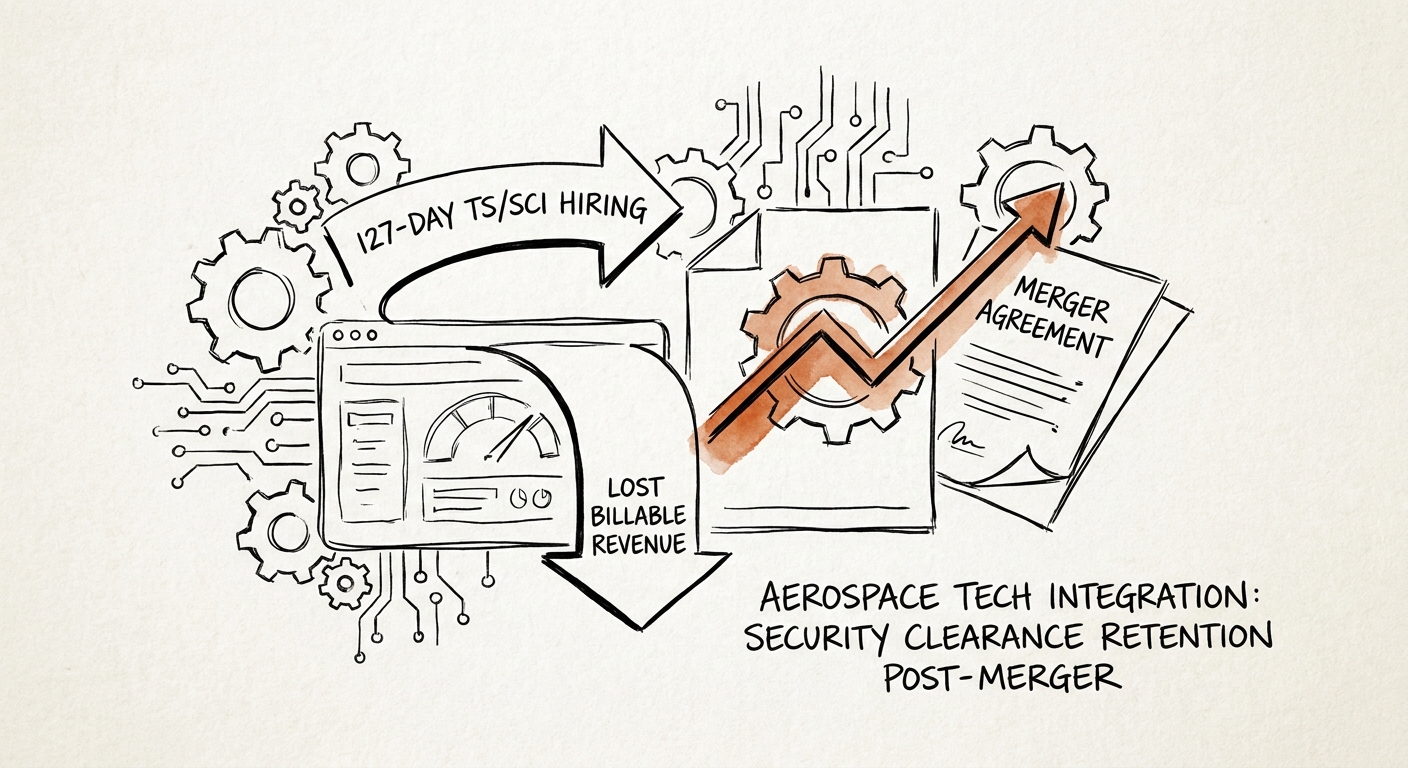
Walk the actual sequence. ClearanceJobs' 2026 Defense Talent Market Report puts time-to-fill for an active TS/SCI engineering role at 127 days, and specialized Model-Based Systems Engineering seats routinely sit empty for 180 to 240. If you cannot poach someone already cleared and instead sponsor a new candidate, you are even worse off: the National Counterintelligence and Security Center's 2026 processing metrics show a full TS/SCI adjudication averaging 12 to 18 months end to end. There is no purchase order that accelerates that. There is no escalation path. The seat stays dark until Washington says otherwise.
What lulls sponsors into complacency is the headline cost of clearance, which looks trivial — DCSA's 2026 Tier 5 investigation pricing runs just $5,596 for a Top Secret background check. But the investigation fee is a rounding error. The real loss is the empty billable seat. A senior cleared engineer billing at $175 an hour who walks represents north of $170,000 in uncaptured revenue across six dark months — and that ignores the non-billable salaried staff you keep on the bench waiting for the new hire to clear. The deal model treated this as a staffing line item. It was a single point of failure with a security badge.
What to do in the first 72 hours
You cannot hold cleared people with a town hall and a slide about culture. They are calculating something far more concrete the moment the deal closes: is my Facility Clearance still sponsored, is my access uninterrupted, and is the new parent competent enough not to put my eligibility at risk? Answer those three questions in writing, by name, in the first 72 hours. If a cleared engineer shows up to a dead badge reader or loses secure network access for even a day during cutover, the inference is immediate and lethal — the new owner doesn't understand this business — and the recruiter texts start getting answered.
Build the financial mechanics for the defense market specifically, because the generic playbook backfires here. A standard 12-month stay bonus is no defense at all: a prime will simply buy out the unvested balance to take the person. So stop using time-based handcuffs. Tie retention dollars to program milestones instead — structure them as completion bonuses for Key Personnel named on the contract, vesting against delivery of the contract vehicle itself, so the engineer's payout and the program's success move together. It needs to be real money. WorldatWork's 2026 Compensation Programs and Practices Report shows contractors paying retention premiums of up to 35% of base salary to hold active TS/SCI holders through transitions. If your package is built around a one-time check that vests next December, you have brought a coupon to a bidding war.
The structural move that prevents most of this is unglamorous: put your integration lead next to the target's Facility Security Officer during diligence, not after close. The FSO knows where the clearance reciprocity hurdles are, which billets are single-threaded, and which engineers are already restless. Map that before you sign and you can pre-load retention offers for the people who actually carry the contracts. Skip it, and you will blow past every integration timeline benchmark scrambling to replace people who quietly left during the diligence window. Pair the FSO work with a hard Day One IT and security checklist so access never lapses, and read the broader attrition benchmarks as a floor, not a forecast — cleared shops run hotter. Secure the people who hold the keys to the classified mission and the rest of the integration is just paperwork.