The Thursday That Wasn't There
A customer emails your distribution desk on a Monday: "Where's PO 48817?" A rep opens the ERP, sees a quantity on hand, sees the order is "released," and fires back a warm note — "Good news, this ships Thursday." Except the fulfillment system shows two of the five line items are on a vendor backorder, and the contract on that account carries a no-partial-shipment clause. Thursday was never real. Now you've turned a status question into a broken promise, a credit memo, and a phone call you don't want.
That gap — between what one screen says and what's actually true across three screens — is exactly why purchase order follow-up is the best place to point AI first in a services-and-distribution shop. The task is high-volume, repetitive, and the right answer already exists inside your systems. Nobody needs the model to be creative. They need it to stop a confident rep from inventing a ship date.
The evidence base says this kind of grounded, narrow workflow is where mid-market firms actually get returns. The RSM middle-market AI survey and the San Francisco Fed analysis of AI and small businesses both point to the same pattern: adoption rises fastest where the task is bounded and the data is already structured. The OECD report on AI adoption by small and medium-sized enterprises adds the caveat that matters here — the firms that stall are the ones that bolt a chatbot onto messy systems and hope. Purchase order status is structured. The trap is pretending one system holds the whole truth.
Three Systems Have to Agree Before a Word Goes Out
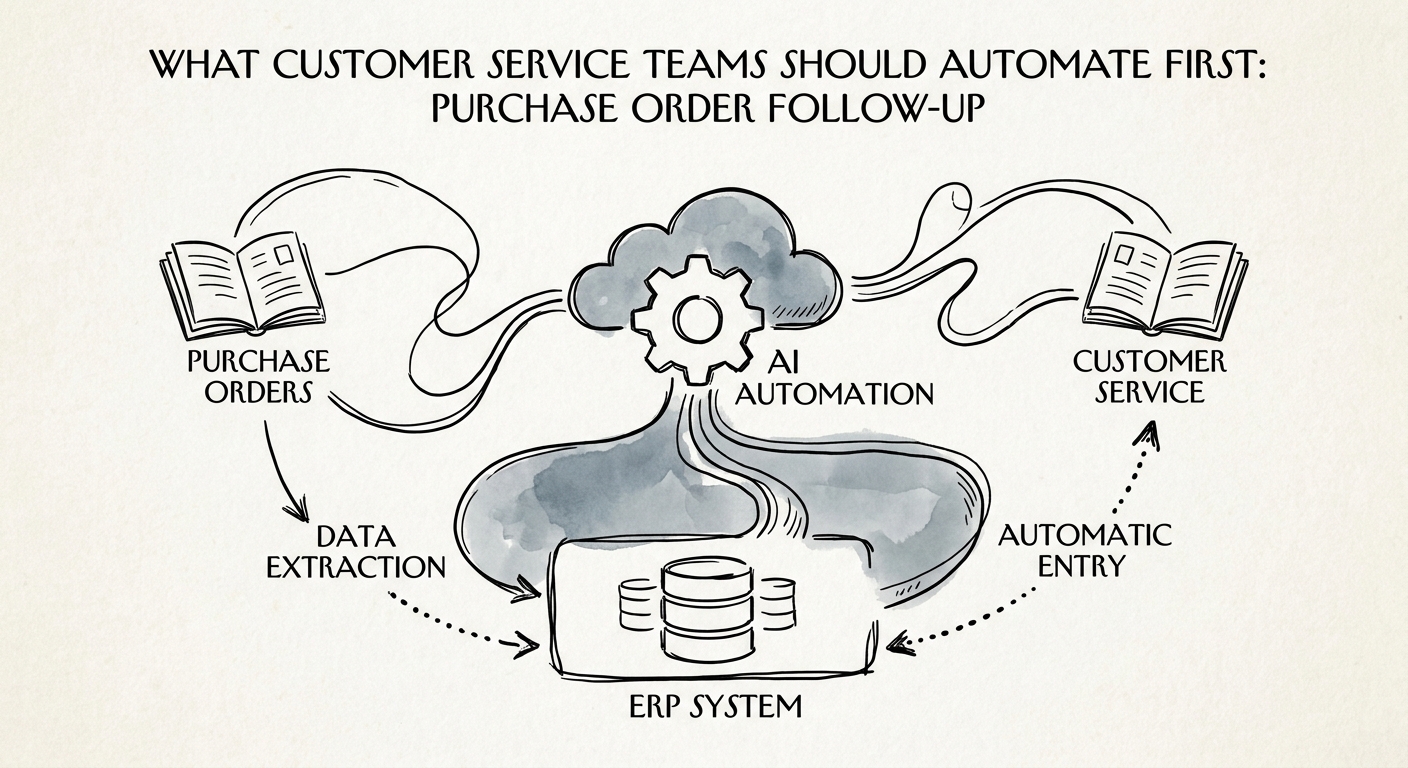
Here is the rule that separates a useful tool from a liability: in a distribution business, an order status answer is the agreement of three records — what the ERP says is allocated, what the CRM says about the account's terms and owner, and what the fulfillment or WMS layer says is physically picked, packed, or backordered. When those three disagree, the order is an exception, not a status update. A model that drafts off the first record it reads will sound fluent and be wrong.
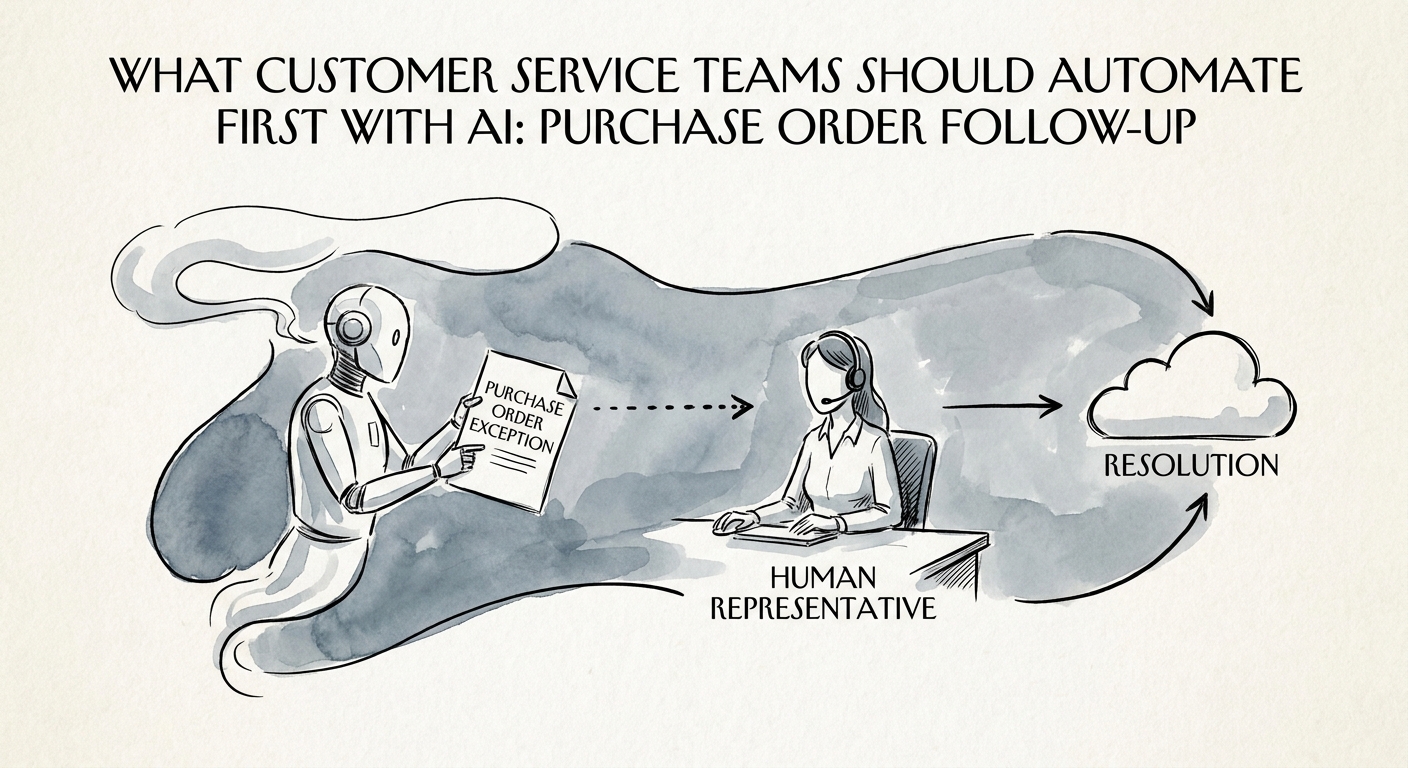
So before you write a single prompt, build the control packet the AI has to fill before it's allowed to draft: PO number, account owner, ERP allocation state, fulfillment/backorder state, the contract constraint on that account (no partials, EDI ASN required, hazmat lead time), the approved promise language for that state, and the send / hold-for-review flag. If any of the three systems can't be reconciled into a clean state, the packet routes to a human — it does not generate a cheerful email. The NIST AI Risk Management Framework is the right scaffold for naming who owns that reviewer decision and what "acceptable risk" means when the downstream cost is a shipment commitment. And because purchase orders carry pricing, customer terms, and sometimes regulated-product details, use the CISA AI Data Security Best Practices to decide which contract fields and customer records the model is even allowed to see, log, or retain.
Practically, this means the model writes the easy 80% — "PO 48817 is confirmed, all five lines ship together Thursday, tracking to follow" — under reviewer signoff, and it is structurally barred from authoring the hard 20%. A backorder, a split shipment a contract forbids, a credit hold: those are deterministic checks that fire before the language model ever runs. The AI drafts on top of a verified state. It never decides the state.
The Metric Isn't "Faster." It's "Reworked Less."
Most teams measure an AI pilot by how quickly it spits out replies. Wrong number. Deloitte's State of AI in the Enterprise 2026 makes the case that production value, not pilot activity, is what separates the tools that stay from the ones that get quietly switched off — and for purchase order follow-up, production value has a precise shape. Track five things: time from PO inquiry to a confirmed answer, percent of AI drafts a reviewer had to correct, how fast an exception gets an owner, customer reply-to-resolution delay, and the one that exposes everything — the order-status mismatch rate, meaning how often the model's draft disagreed with the reconciled truth. If reps are still manually re-checking the WMS after every draft, the tool saved nothing; you've just moved the work.
Before you build, confirm this workflow is even the right first target using the manual-work scoring guide, then sequence the source cleanup, prototype, reviewer training, and scale gates with the 90-day AI implementation plan. Don't boil the ocean on day one. Pick one order type — say, stocked SKUs to your top accounts where terms are clean — and require the reviewer to accept or reject each draft with a one-click reason. That reason log is your training signal and your audit trail at once.
And name the lines that stay human, in writing, before launch: late fulfillment changes, contract disputes, partial-shipment exceptions on no-partial accounts, and any message touching price. Those don't get a faster draft — they get a different approval path. Scale the automated lane only when your service desk answers a routine "where's my order" measurably faster without a single rep ever putting a ship date in writing that the systems can't back up. That's the whole game: speed on the routine, discipline on the promise.
