
The practical answer
- Short answer
- Learn how marketing agencies use RAG AI knowledge systems to automate sales enablement search, enforce data governance, and reclaim billable hours.
- Best fit
- Industry: Marketing & Advertising. Function: Sales Enablement
- Operating path
- AI Knowledge Systems → AI Transformation
- Key metric
- 440 Hours per year wasted on manual search by sales reps
Marketing agencies are bleeding pipeline capacity because their deal desks and strategists spend up to 440 hours a year, according to Gartner's sales enablement research, acting as human search engines for historical pitch decks and case studies. You hire brilliant creative strategists and seasoned account executives, and then you force them to spend 20% of their week digging through deeply nested, poorly named cloud folders trying to find that one slide where you showed a 40% ROI for a CPG brand. This is the hidden administrative tax on your agency's growth. Every time an RFP drops, the scramble begins. Your team blasts Slack channels begging for relevant past performance metrics. They rebuild slides that already exist. They reinvent messaging that was perfected three years ago. The problem isn't a lack of sales talent; it is a fundamental failure of knowledge retrieval.
In our last engagement with a mid-market marketing agency, I watched their top strategists burn 15 hours a week just digging through unstructured cloud storage to build a single competitive response. They had the right data to win the pitch, but it was locked in the digital equivalent of a landfill. The promise of generative AI is supposed to fix this. McKinsey estimates that generative AI can increase global sales productivity by 3 to 5 percent. But throwing a generic AI chatbot at your sales team won't magically organize your chaotic file systems. If you want to stop the margin bleed, you must build a structured AI Knowledge System powered by Retrieval-Augmented Generation (RAG). Before you build it, however, you have to understand the difference between a secure RAG architecture and a risky data dump. For agencies looking to evaluate their readiness for this shift, I strongly recommend reviewing The Operator's AI Readiness Assessment for a 100-Person Marketing Agency.
The problem isn't a lack of sales talent; it is a fundamental failure of knowledge retrieval. Stop paying strategists to search. Let the AI do the hunting.
Retrieval-Augmented Generation (RAG) vs. The Cloud Drive Dump
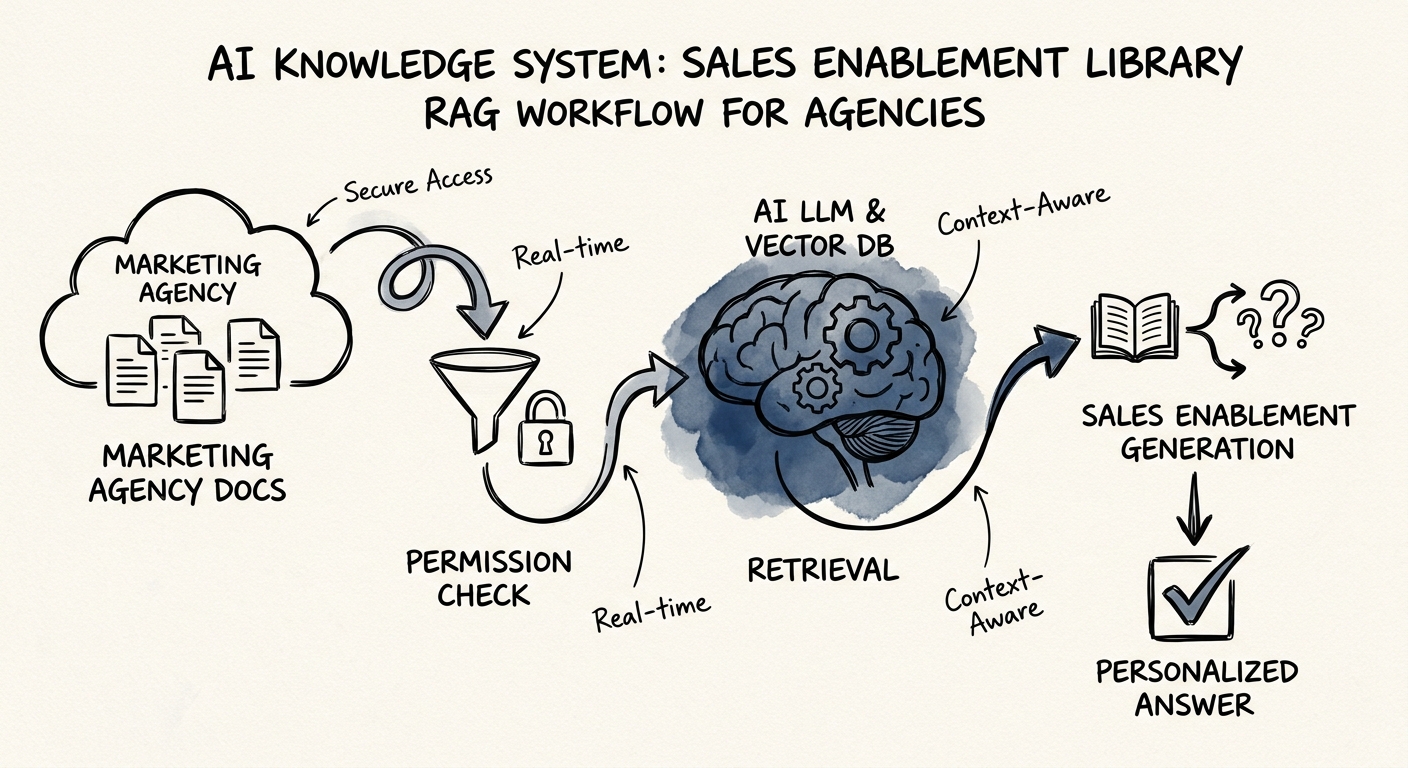
The most common mistake agency operators make is assuming they can just point a commercial large language model at their shared drives and let it index everything. This is how you breach client NDAs and destroy trust. When you build an AI Knowledge System for sales enablement, source quality and access control are paramount. PwC's 2024 Global Digital Trust Insights survey found that an alarming 63% of senior executives feel comfortable using GenAI tools without data governance policies in place. In a marketing agency, that lack of governance is fatal. If your AI knowledge assistant does not respect file-level permissions, a junior sales development rep querying the system for pricing benchmarks might suddenly receive a detailed summary of a confidential margin analysis meant only for the executive team. Worse, they might accidentally cross-pollinate proprietary strategy from one client into a pitch for their direct competitor.
A proper RAG architecture solves this problem. Rather than training the AI on your data—which bakes your confidential information into the model itself—a RAG system securely retrieves specific, permission-cleared documents related to the user's query, and then uses the AI only to summarize those exact documents. The knowledge system must inherit the access rights of the user asking the question. If the user cannot open the source file in your core repository, the AI must pretend that file does not exist. Furthermore, source quality dictates output quality. Your AI is only as smart as the enablement library it searches. If your repository is filled with V1, V2, and VFINAL_FINAL versions of a pitch deck, the AI will hallucinate conflicting data points. The prerequisite to an AI Knowledge System is a ruthless data cleanup. You must archive the obsolete garbage and establish a single source of truth for approved case studies, pricing frameworks, and service level agreements. For teams looking to formalize this documentation, consider reading Building an AI Knowledge System for Your Sales Enablement Library as a starting template.
Retrieval Testing, Ownership, and the Path to ROI
Once the data is clean and the permissions are mapped, the success of your AI Knowledge System hinges on retrieval testing. You cannot blindly trust an AI's summary of your agency's capabilities. Every claim the AI generates must include a direct, clickable citation back to the original source document. When an account executive asks what the average ROAS improvement was for SaaS clients last year, the bot should answer clearly and immediately link to the Q3 strategy deck where that statistic lives. If the AI cannot cite its source, it should be programmed to admit it doesn't know. This strict citation requirement builds trust with your sales team and ensures they aren't pitching fabricated metrics to prospective clients. Driving adoption requires clear ownership. An AI knowledge assistant is not an IT project you deploy and forget; it is a living operational asset. Your Revenue Operations or Enablement leader must own the system. They are responsible for monitoring the questions sales reps are asking, identifying where the AI fails to find answers, and actively uploading the missing case studies to fill those knowledge gaps.
The financial upside of getting this right is massive. Forrester research shows that companies with structured opportunity management processes achieve 43% higher win rates. An AI Knowledge System enforces that structure by democratizing access to your agency's best intellectual property. Adding to this efficiency, Bain & Company's assessment reveals that organizations deploying GenAI effectively reduce administrative tasks by 20%, freeing up capacity for actual client engagement. It levels the playing field, allowing a rep in their third month to pitch with the institutional knowledge of a five-year veteran. The agencies that thrive in the next three years will not be the ones that hire the most salespeople. They will be the ones that systemize their historical wins, govern their data ruthlessly, and arm their deal desks with instant access to the right insights. If your team is still spending hours searching for past deliverables, you are already losing to an agency that isn't. To understand how to operationalize this search capability effectively across your revenue engine, read What Sales Teams Should Automate First with AI: Internal Knowledge Search.