
The practical answer
- Short answer
- Discover why 75-person accounting firms fail their first AI pilot and how a true readiness assessment compresses your monthly close cycle by fixing the data foundation first.
- Best fit
- Industry: Professional Services. Function: Finance & Operations
- Operating path
- AI Transformation Strategy → AI Transformation
- Key metric
- 30% Average operational cost reduction for accounting firms executing structured AI deployments.
75-person accounting firms are bleeding up to 30% of their operational margins on unstructured document triage while partners chase the illusion of AI-automated tax returns. I see this exact failure pattern every week. A firm hits the $10 million to $15 million revenue ceiling. To break through, the partners assume they need to buy a generative AI tool to write complex tax strategies or instantly finalize month-end reconciliations. They purchase off-the-shelf wrappers, hand them to overwhelmed senior accountants, and wonder why utilization rates remain abysmal. The problem is not the technology; the problem is the data scaffolding. You cannot automate a process that relies on client receipts thrown into a shoebox or PDFs attached to disjointed email chains. When your staff spends hours manually cross-referencing these chaotic inputs, your error rates climb and your realization rates plummet.
We saw this pattern at a regional firm last quarter. They attempted to deploy a large language model to draft client advisory memos. It failed spectacularly because the underlying data was a fragmented mess of inconsistent nomenclature and buried context. They ignored the fundamental reality that AI is entirely dependent on structured, clean inputs. According to McKinsey's 2024 analysis of Gen AI adoption, generative AI has the potential to automate 60% to 70% of standard worker activities that consume time. But you only capture that value if the foundational data is machine-readable. When you bypass the unglamorous work of standardizing your intake, you are simply paying a premium to generate hallucinations faster.
The industry is beginning to recognize this disconnect between expectation and reality. The Thomson Reuters 2025 Generative AI in Professional Services Report reveals that while 68% of tax and accounting professionals are optimistic about AI's potential, a mere 21% have actually pushed it into broad operational use. The gap between that 68% optimism and 21% execution is entirely filled by firms that failed their initial readiness assessments because they tried to run before they could walk.
If you do not standardize your document intake before turning on an AI agent, you aren't transforming your firm—you are just automating your own operational chaos.
Automating the Margin Leaks First
If you want to build true enterprise value, you must stop trying to automate complex advisory work and start automating the administrative margin leaks. In my experience, the firms that successfully cross the 75-person threshold are the ones that ruthlessly attack low-variance, high-volume tasks. We mandate that our clients focus their initial AI deployments on document intake, CRM hygiene, and variance note generation. Think about the sheer volume of bank statements, payroll registers, and disorganized expense receipts your firm processes during peak tax season. These are the back-office black holes that drain your most expensive talent. When you force a $150-per-hour CPA to manually extract line items from a scanned vendor invoice, you are destroying your firm's profitability.
The smartest operators in the space are already making this pivot. Consider KPMG's AI audit platform capabilities; their proprietary tools do not begin by writing the final audit opinion. Instead, they ingest unstructured source documentation, extract the necessary data electronically, and generate the foundational workpapers before an auditor even touches the file. This is the exact blueprint a mid-market firm must follow. By automating the extraction layer, you free your team to focus on the interpretation layer. I strongly advise managing partners to evaluate the best first AI use cases for accounting firms, which universally prioritize administrative data processing over client-facing advisory generation.
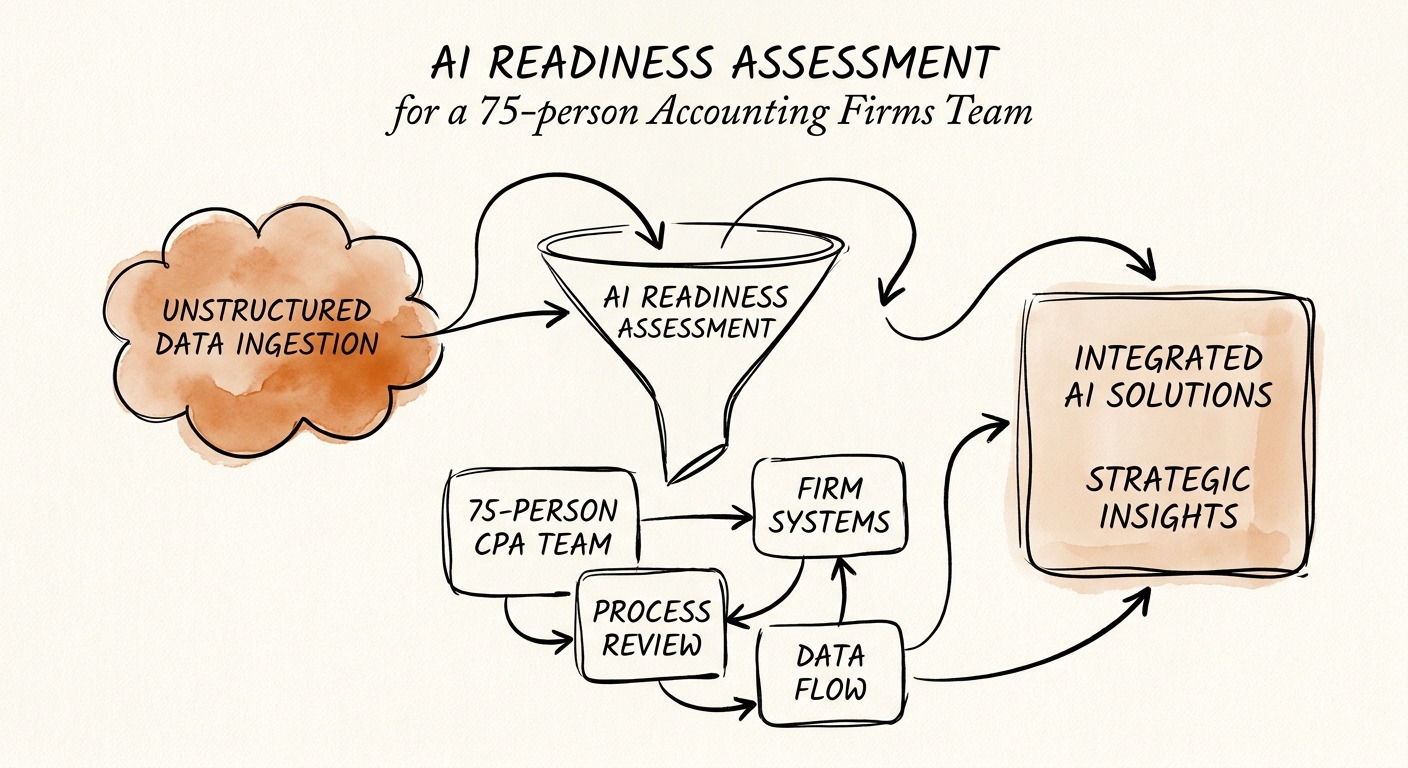
Before you deploy a single autonomous agent, you must execute rigorous data cleanup. If your historical financial records, client correspondence, and entity structures are not meticulously tagged and stored in a centralized repository, your new AI tool will choke on the variance. We rebuild these intake workflows for our clients so that every document follows a rigid, programmable path from receipt to reconciliation. This unglamorous architectural work is the absolute prerequisite for scaling AI efficiently.
The Infrastructure of AI Readiness
You cannot buy AI readiness; you have to build it through relentless operational discipline. When we assess a 75-person firm, we look directly at their process documentation and governance frameworks. If your workflow lives exclusively in the heads of three senior managers, your firm is un-automatable. A successful AI transformation requires explicit, standardized operating procedures that dictate exactly how edge cases are handled. It requires a complete audit of your existing technology stack, identifying legacy systems that refuse to integrate via modern APIs, and systematically replacing them with extensible platforms. You must document the exceptions before you can train a model to route them. This is the core of our AI transformation services for growing businesses: turning tribal knowledge into programmable logic.
The financial impact of getting this infrastructure right is undeniable. MIT Sloan Management Review's analysis of AI in accounting makes the case that when firms let machines handle the boring, structured work, accountants reclaim meaningful time from routine data entry and redirect it toward higher-value advisory work, materially compressing the monthly close cycle. That is not a marginal improvement; that is a fundamental re-rating of your firm's capacity. You reclaim billable time every single month by simply letting the machine handle the structured extraction.
Furthermore, the bottom-line benefits are immediate once the foundation is solid. The PwC 2024 AI Business Survey indicates that accounting firms that successfully implement AI report an average operational cost reduction of 30%. That 30% drops straight to the bottom line, providing the capital necessary to acquire smaller, less efficient competitors. But you only unlock these economics if you treat AI as an infrastructure project rather than a software subscription. We force our clients to lock down access controls, enforce strict naming conventions, and build a unified data taxonomy. Only then do you earn the right to turn on the AI.