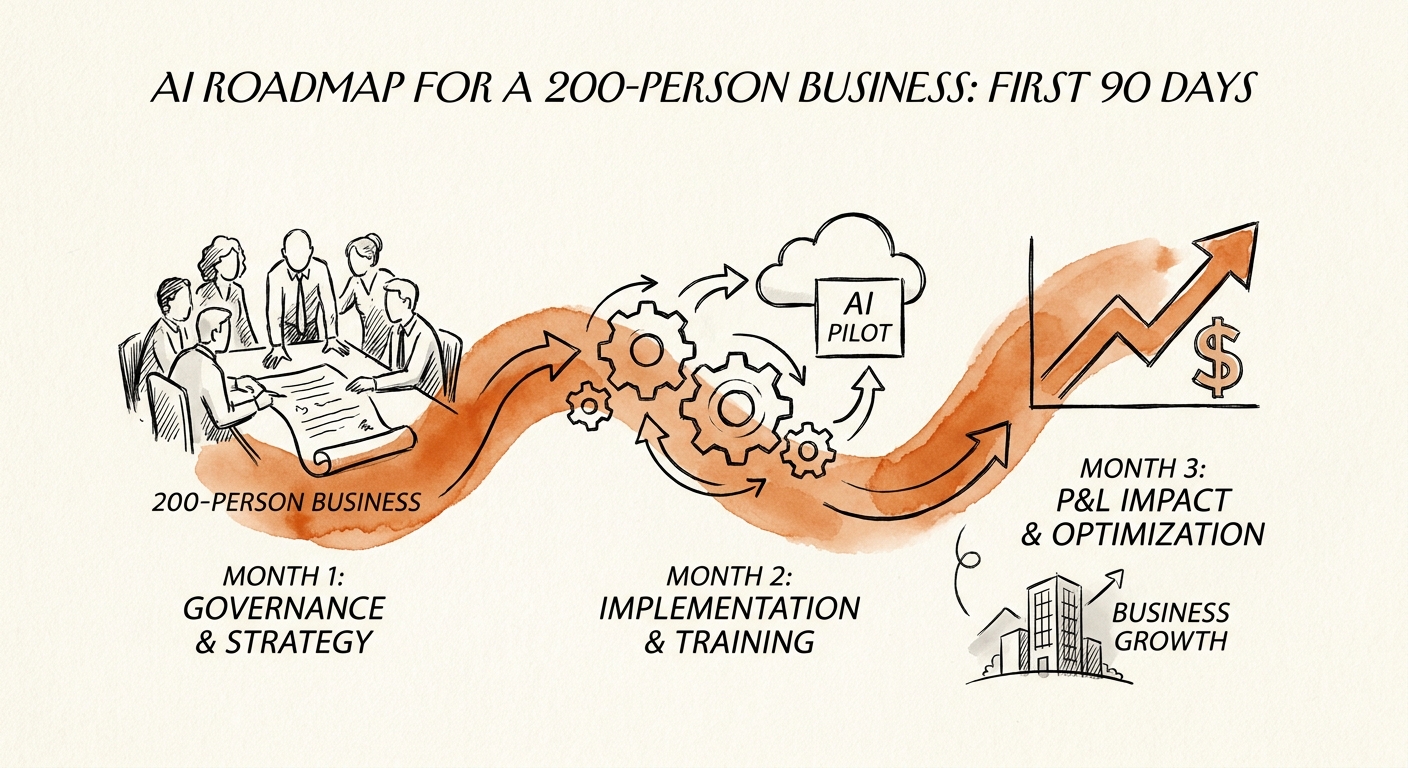
The 200-person trap: enough complexity to need AI, no one whose job is to run it
A 200-person company sits in an awkward spot. You are big enough that sales, service, finance, and ops have hardened into separate fiefdoms, each with its own spreadsheets and its own version of the truth. But you are still too small to have a CIO, a data team, or anyone whose actual job title includes "AI." So when the board or a competitor spooks leadership into "we need an AI strategy," the request lands on someone who already has a full-time job, and it usually turns into a vendor bake-off that produces a deck and nothing else.
The pressure is real and it is documented. The RSM middle-market AI survey shows adoption accelerating right in your size band, and the San Francisco Fed analysis of AI and small businesses shows the same urgency pushing down to even smaller shops. So the question for the first 90 days is not whether to act. It is how to convert that pressure into one operating result instead of a portfolio of stalled experiments.
Spend month one finding the workflow, not the tool. Walk each department and ask one question: what repeated task makes a competent person sigh on a Monday? Say a 200-person services firm finds that finance re-keys the same vendor invoices into two systems, support drafts the same five answers from scratch all day, and a sales coordinator manually stitches CRM notes into proposals. Those are your candidates. Score each on value, data readiness, how clearly a human can review the output, system access, risk, and how hard adoption will be. Use the AI project use-case scoring model to rank them honestly. The winner should be important enough that fixing it gets noticed, and narrow enough that one person can own it without a transformation program wrapped around it.
Month two: design a pilot that survives contact with your messiest department
Here is what kills pilots at your scale. The workflow you picked crosses two of those fiefdoms, the data lives in a system the owner cannot fully access, and there is no agreement on who checks the output before it goes out the door. The pilot looks fine in a demo and collapses the first week someone in accounting says "that number is wrong and it is not my job to catch it."
The OECD report on AI adoption by small and medium-sized enterprises is worth reading precisely because it refuses to treat adoption as just buying access. It names what you actually need: data readiness, skills, a real workflow owner, and governance. At 200 people you will not have all four lined up, so the pilot design has to make them explicit. Write down the approved data sources, who is allowed to use the tool, who reviews the output and against what standard, what happens when the AI gets it wrong, what training people get, and how you will know it worked.
The NIST AI Risk Management Framework gives you the spine for that without the enterprise overhead: govern, map, measure, manage. Translated for a company your size, it means the pilot has a named owner, a documented workflow, scoped data access, a hard human-review rule, and a weekly measurement check before anything touches live customer or financial work. Before you launch, run the AI readiness assessment on that specific workflow. If it surfaces a material gap, like the invoice data being too inconsistent to trust, fix the workflow first. Adding AI to a broken process at 200 people just industrializes the mess faster.
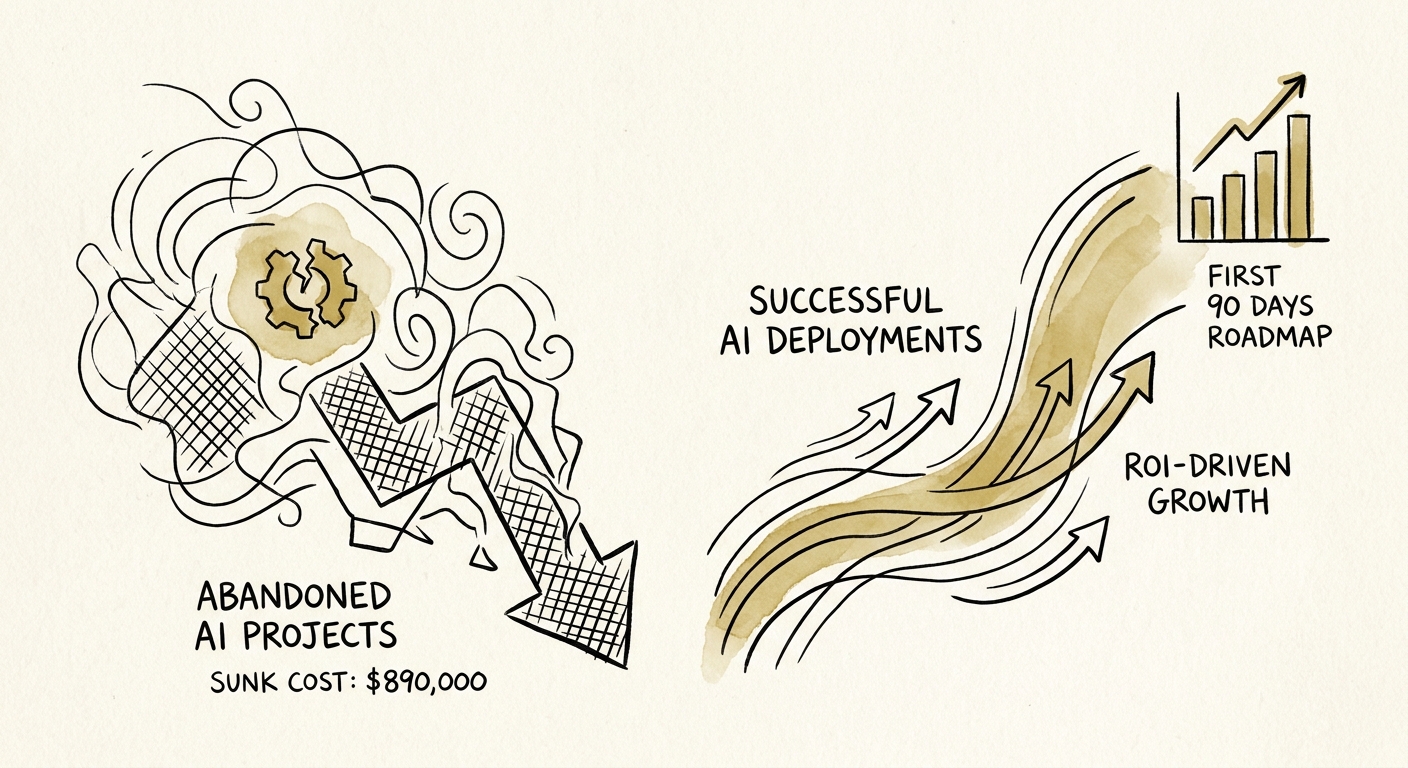
Month three: earn the right to scale by proving one workflow paid off
By day 60 you have a working pilot. Month three is where most companies your size quietly let it drift, because the person running it goes back to their day job and no one defends the result. Do the opposite. Put the workflow into a weekly value review: what did it actually save, where did users push back, where did quality slip, what training closed the gap. At the end of the 90 days, you make one decision out loud in front of leadership: expand it, hold it where it is, or stop.
This is the discipline the Deloitte State of AI report keeps pointing at, treating the chasm between a working pilot and real business value as an operating problem, not a tooling one. And the Gartner agentic AI project forecast spells out the failure mode: projects get killed when leaders cannot show value, cost, and risk controls in plain terms. At 200 people you do not get a second budget conversation if the first one was hand-waving. Proving a single invoice or support workflow gives you the evidence to ask for the next two.
If you want to turn this into named owners, controls, and production checks instead of good intentions, use the 90-day AI implementation plan as the scaffold. The goal at the end of the quarter is not a roadmap with twelve initiatives. It is one workflow you can point to, with a number attached and a person who owns it.