
The practical answer
- Short answer
- Most alliance programs at $10-50M ARR are press releases, not pipeline. The fix isn't more partners — it's rebuilding the deal around the partner's margin, not yours.
- Best fit
- Industry: B2B Technology & SaaS. Function: Revenue Operations & Sales Strategy
- Operating path
- GTM Execution → Commercial Performance → Performance Improvement
- Key metric
- 18 Months of payback required for standard direct outbound, forcing companies to pivot toward alliance-driven CAC reductions.
The 200-Partner Program That Sourced Three Deals
Picture a $24M ARR SaaS company. Two years into a "partner-first" push, the dashboard looked healthy: 214 signed partners, a slick portal, a quarterly newsletter, a "Partner of the Year" award. Then you pull the revenue attribution and the floor drops out — partners sourced three closed deals all year. Total. The other 211 logos signed the agreement to get a co-marketing tweet and then went dark.
This is the default state of alliance programs at $10M to $50M ARR, and it has nothing to do with how many partners you've recruited. It's that the founder-CEO built the program around a fantasy: that a system integrator or a complementary ISV would carry your product into their deals out of goodwill, because the integration is "strategic." Partners do not move pipeline for strategy. They move pipeline when your software makes them money — when it pulls through implementation hours, managed-service retainers, or consulting work their bench can bill. If you can't draw that line on a napkin, you don't have a partner, you have a directory listing.
The reason this matters more every quarter is that your direct motion is quietly losing the room. Gartner's 2025 B2B Buying Research found buyers spend just 17% of the purchase journey talking to any seller at all — and that sliver is split across every vendor on the shortlist. Your AEs are fighting over a fraction of a fraction. A partner who is already embedded in the account doesn't fight for that 17%; they are the trusted advisor shaping the other 83%. That's the asset you're leaving on the table.
A partner who can't tell you how your product feeds their services bench is not a partner. They are a logo on your website who will never send you a single deal.
The Margin Math That Actually Recruits Partners
Here's the reframe that turns dead logos into a real channel: stop pitching your features and start engineering the partner's gross margin. A global SI doesn't lose sleep over your UI. They lose sleep over bench utilization. So the conversation that lands is not "look at our API" — it's "for every license of ours your client buys, your team books roughly X weeks of implementation and an ongoing configuration retainer." Map your deployment methodology straight onto their service catalog line items. The moment a partner's delivery lead can see your product as a billable services multiplier, recruitment stops being a sales problem.
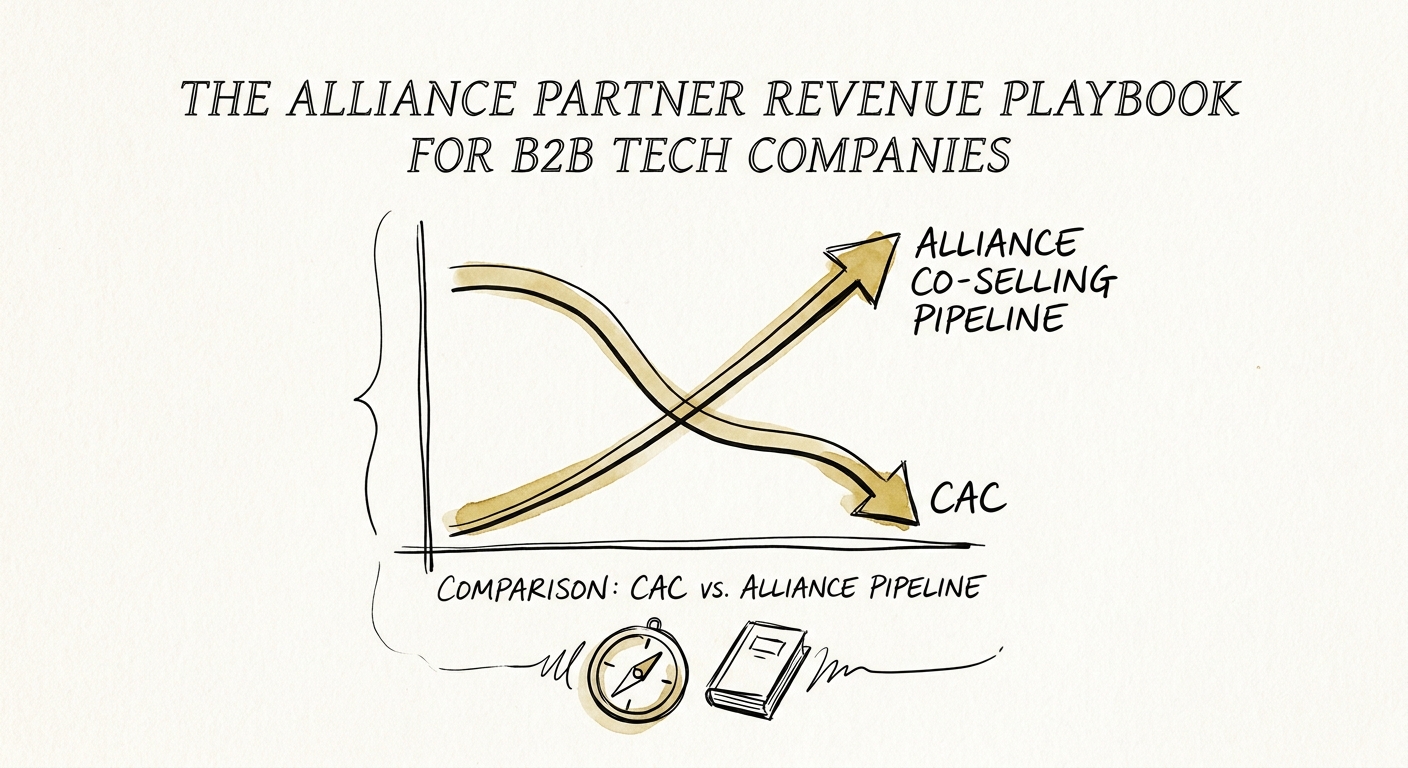
The unit economics on the other side are why founder-CEOs should treat this as the primary motion, not a side bet. Direct outbound at the mid-market has gotten brutally expensive — CAC payback north of 18 months is now common, between rising paid-search costs and cold sequences that quietly torch your domain reputation. Partner-sourced deals invert that: the partner has already done the trust-building and the budget scoping, so win rates on that pipeline routinely run past 45% versus the 15-20% you grind out on cold outbound. The market sees it coming — Forrester's 2025 Partner Ecosystem Marketing Survey reports 67% of B2B decision-makers expect indirect revenue to grow more than 30% year-over-year, and Harvard Business Review's 2025 analysis of tech partnerships ties integrated partnerships to growth lifts of up to 25%.
The compounding payoff shows up in retention. When your product is wired into a partner's broader stack or sits underneath their managed-service offering, ripping you out means breaking their delivery — so they defend the renewal for you. That's the structural stickiness behind the numbers in McKinsey's 2025 Net Revenue Retention benchmark, where top-quartile B2B SaaS holds NRR around 113%. You don't reach 113% selling a standalone tool a buyer can swap on a whim. You reach it by becoming the layer their partner's whole engagement is built on. For how this same logic reshapes your acquisition costs, our 2026 CAC payback diagnostic goes deeper.
What to Build Before You Sign Another Partner
The execution failure mode is almost always the comp plan, not the partner. If your AE earns full quota credit on a deal they sourced solo but takes a haircut — or a turf war — when a partner is involved, your reps will actively starve the channel to protect their number. Fix the compensation structure first: an AE should be made whole, or better, on a partner-influenced deal. Until that's true, no portal or enablement deck will save you, because the people closest to revenue are incentivized to sabotage it.
Then assign a real owner. A successful alliance motion needs dedicated headcount whose only job is partner pipeline — not a product marketer doing it on the side. And measure the two things that actually predict revenue, not the vanity stats. Kill "number of certified partners" and "portal logins" from the board deck. Track partner-sourced pipeline velocity and partner-influenced closed-won, and watch your sales-cycle compression. Those three move your valuation; the rest is theater.
This is no longer optional in the current capital environment. Bain & Company's 2026 Global Private Equity Report puts average hold periods near seven years — which means a buyer is underwriting whether your growth can survive without bolting on a new AE for every incremental dollar. A defensible partner channel is exactly the kind of distribution that scales without linear headcount, and acquirers price it accordingly. Before you recruit your next ten partners or rework your pricing tiers, do two things: pressure-test your margin against your B2B discounting framework so you can actually fund partner economics, and read how acquirers underwrite this channel in our breakdown on valuing channel partner revenue streams.