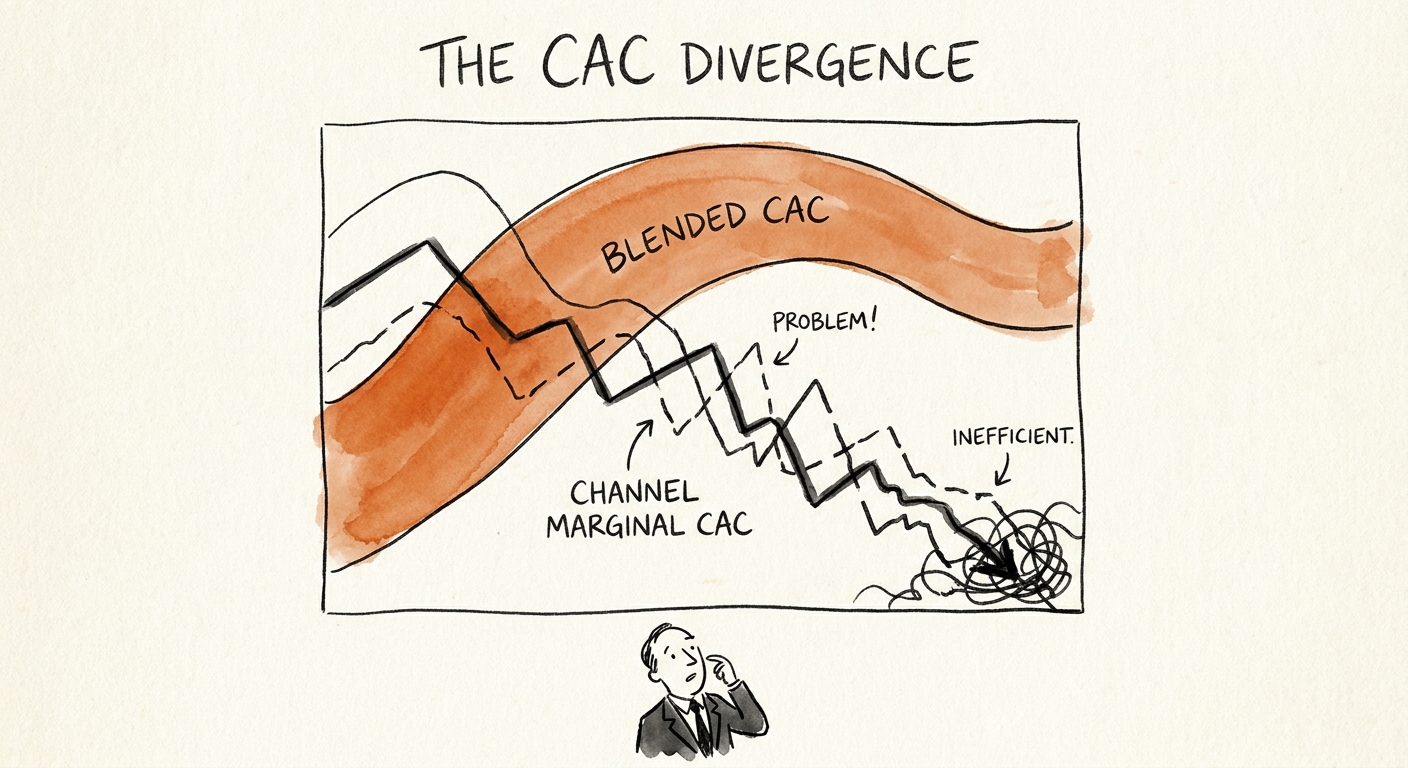
The slide said 14-month CAC payback. The management team of a $40M ARR portfolio company presented it the way you present a clean bill of health: one number, healthy, next topic. So we pulled the thread. We separated their high-intent organic inbound from the outbound SDR motion and the paid search line — and the paid search CAC came back at $48,000, a 38-month payback. The blended figure wasn't a metric. It was a blanket thrown over a channel that was structurally underwater, and the organic engine was holding the average up all by itself.
This is the failure mode of every blended CAC number in the $10M–$100M ARR band: you divide total sales and marketing spend by total new logos, and in doing so you let zero-marginal-cost organic acquisition quietly cross-subsidize your most inefficient paid and outbound motions. The math is doing exactly what it's designed to do — average — and the average is lying to the board. Forrester's 2025 B2B Customer Acquisition Benchmark captures the gap precisely: paid search CAC in B2B SaaS climbed 42% over 24 months, while the blended CAC at those same companies moved only 12%. A channel can triple its cost and the headline number barely flinches. That is not stability. That is camouflage.
The brand subsidy is paying your worst channel's rent
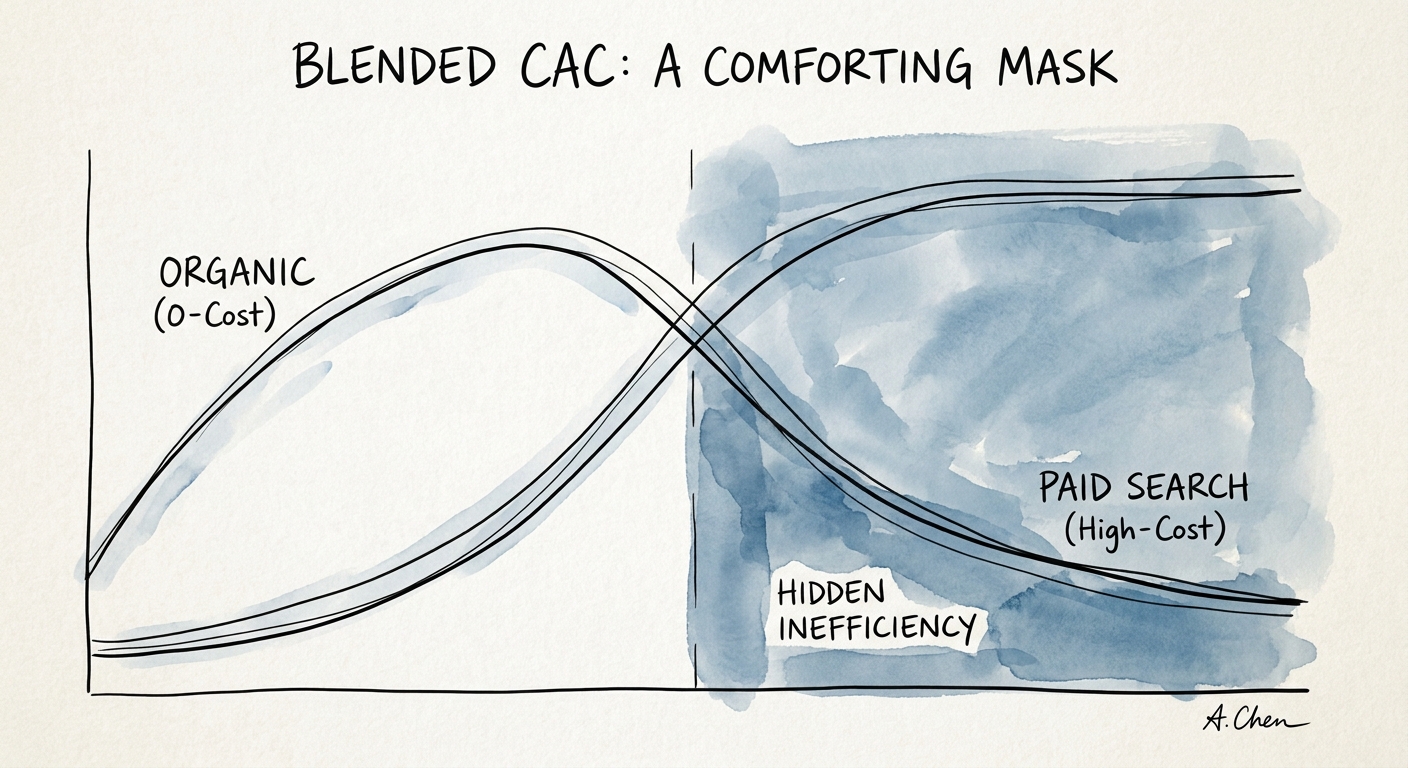
Here's the mechanism, and once you see it you can't unsee it. As a software company matures, its brand, partner ecosystem, and organic search footprint start throwing off a steady baseline of high-intent, near-free pipeline. That baseline is real and it's valuable — but it becomes the slush fund that marketing leadership uses to keep bloated paid social, field events, and outbound budgets looking acceptable. The good channel pays the bad channel's rent, and the blended line lets nobody notice the transaction. Gartner's 2025 CMO Spend Survey puts a number on the imbalance: 64% of discretionary marketing budget flows to paid channels that produce just 22% of closed-won pipeline. Average that 64% against the 22%-producing engine that's actually free, and the CFO sees a tolerable aggregate and signs off on the next cycle.
The reason this matters for a PE operating partner specifically: it breaks your investment thesis the moment you act on it. You underwrite a $5M marketing injection assuming new customers arrive at the historical blended rate. They don't. The organic engine cannot scale on command — it scales with brand and time, not budget — so your marginal customer costs whatever your most expensive paid channel costs, not your comfortable blended average. Pitchbook's 2025 SaaS Unit Economics Report finds fully loaded outbound CAC now running roughly 3x inbound organic CAC across mid-market software. When you force the channel split during diligence or the first 100 days, the spread is even uglier: Bain & Company's 2025 Private Equity Value Creation report shows operators who mandate channel-specific CAC separation post-close routinely uncover a 3.5x variance between the best and worst channel inside the same company. That variance isn't noise. It's where the EBITDA is hiding. If your CAC payback math still doesn't add up after the split, the deeper diagnostic on why your CAC payback period is lying to you walks through the rest.
What to demand on Monday: one marginal dollar
Stop asking what your customers cost on average. Start asking a single, brutally specific question of every portfolio CFO: if we spend one more dollar on LinkedIn, or hire one more SDR, what does that customer cost? That's the marginal CAC, and it's the only number that predicts what your next tranche of capital actually buys. Concretely, this week: pull S&M spend apart by channel — paid search, paid social, events, outbound headcount fully loaded, organic — and divide each by the logos it actually sourced, not the logos it claimed in a multi-touch model that gives organic the assist on every deal. Then sort the list. The channel at the bottom is the one your blended number has been protecting, and it will usually be the one with the most budget.
This isn't financial pedantry; it's a valuation lever. McKinsey's 2025 B2B Growth Benchmark found that companies allocating spend on marginal, channel-specific CAC rather than blended CAC posted 28% higher EBITDA margins within four quarters. The move is mechanical once you've split the channels: cut the dead weight, redeploy the freed capital into the engines that actually convert efficiently, and rebuild your comp plans and synergy underwriting on the marginal numbers instead of the historical blend. For the channel-by-channel ROI picture that informs where to redeploy, see why organic acquisition ROI is crushing paid in B2B SaaS. Walk into the next board meeting with the split, not the blend. One number you can hide behind. Five you have to defend — and only the five tell you whether your growth engine is economically real.