The two-line change that crashed billing
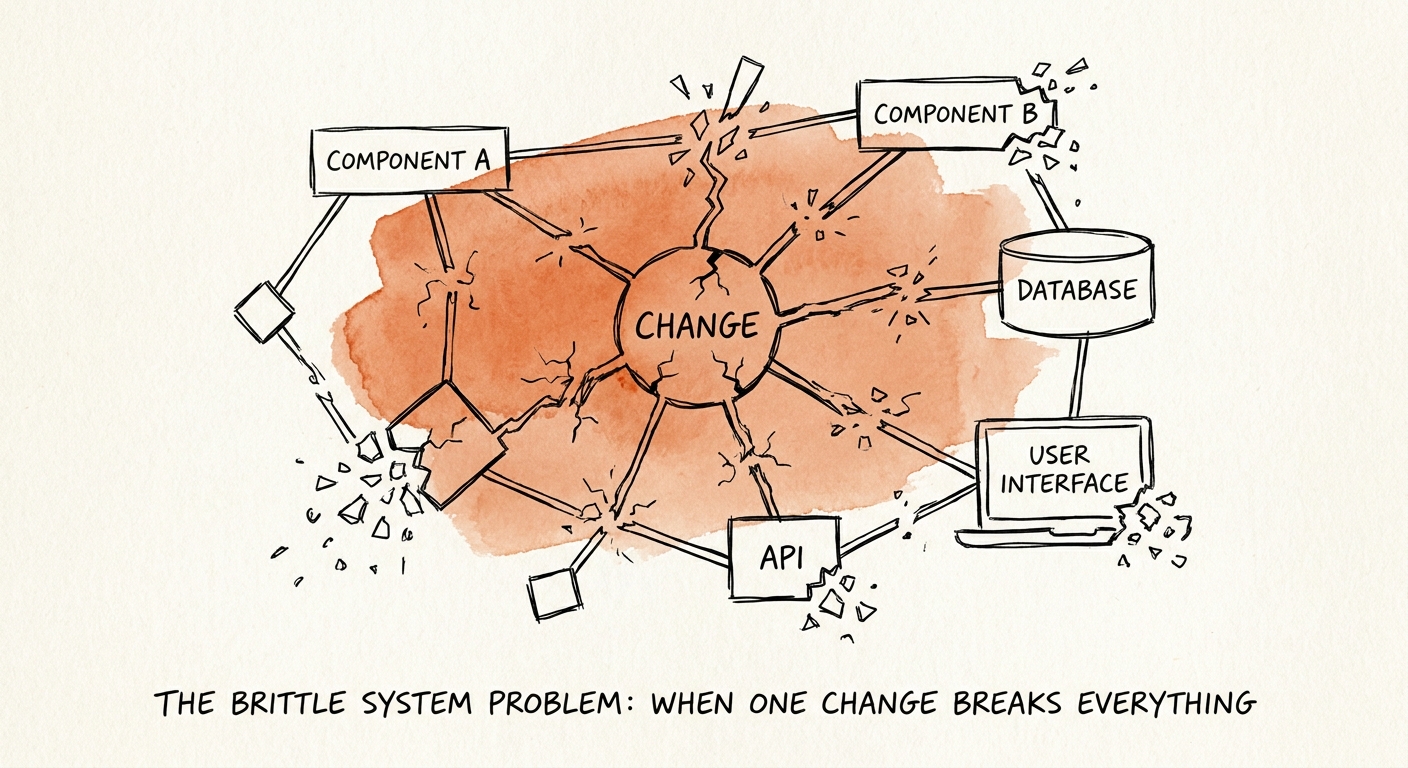
An engineer at a $40M ARR fintech I was evaluating shipped a tweak to a reporting dashboard — the kind of change you'd expect to be invisible. Instead, the payment gateway went dark for 14 hours. Nobody touched billing. Nobody intended to touch billing. But the reporting module read straight out of a table the gateway also wrote to, and a schema assumption that had held for three years quietly stopped holding. That is the brittle system problem in one sentence: a change you can't reason about in one place breaks something you weren't looking at in another. The blast radius of every edit is the entire platform, and no one on the team can tell you in advance how big it will be.
This is not bad luck. It's accrued interest. Early on, a founding team ships features by reaching directly into whatever data and state is closest, because boundaries cost time you don't have at ten customers. By two hundred customers, those shortcuts have fused the system into a single organism where nothing can be changed in isolation. Gartner's 2025 SaaS Engineering Productivity Benchmark found that teams stuck in these environments burn 38% of their week just mapping undocumented dependencies before they can write a line of new code — and that's the optimistic read, because it doesn't count the regressions they ship anyway.
I've stood up engineering teams three times, and tight coupling is the fastest way I know to destroy both morale and enterprise value at the same time. The morale half is obvious: smart people quit when every Tuesday is a minefield. The value half is what founders miss. McKinsey's 2025 Developer Velocity analysis ties monolithic, tightly-coupled architectures to time-to-market up to 45% slower than modular peers. For a sponsor, that translates directly into a holding period that keeps stretching while competitors ship past you. If you want to see how that drag converts into actual dollars on the EBITDA line, our technical debt quantification framework walks the math.
I read your fragility off the deploy calendar
Here's the diligence trick I rely on: I can grade architectural risk before I'm granted repo access, just from how a team ships. Mandatory two-week code freezes. Weekend-only deploys, because that's when fewest customers are watching. A standing army of manual QA clicking through the app before every release. None of those are process discipline — they're confessions. They're a team telling you, through their calendar, that they don't trust their own system to survive a change on a normal afternoon. I log every one of these as a primary entry on my technology due diligence red flags list.
The fear is expensive in a specific, compounding way. When releases slip from daily to monthly, the batch size of each deploy balloons — and big batches are where catastrophic failures live, because when something breaks you're untangling a hundred changes at once instead of one. The downtime that follows isn't a rounding error. Forrester's 2026 Cost of Downtime report puts unplanned deployment rollbacks at an average $14,500 per minute for enterprise SaaS providers, between SLA penalties, lost customer productivity, and the brand damage you can't claw back. A single bad Friday-night push can erase a quarter of margin gains.
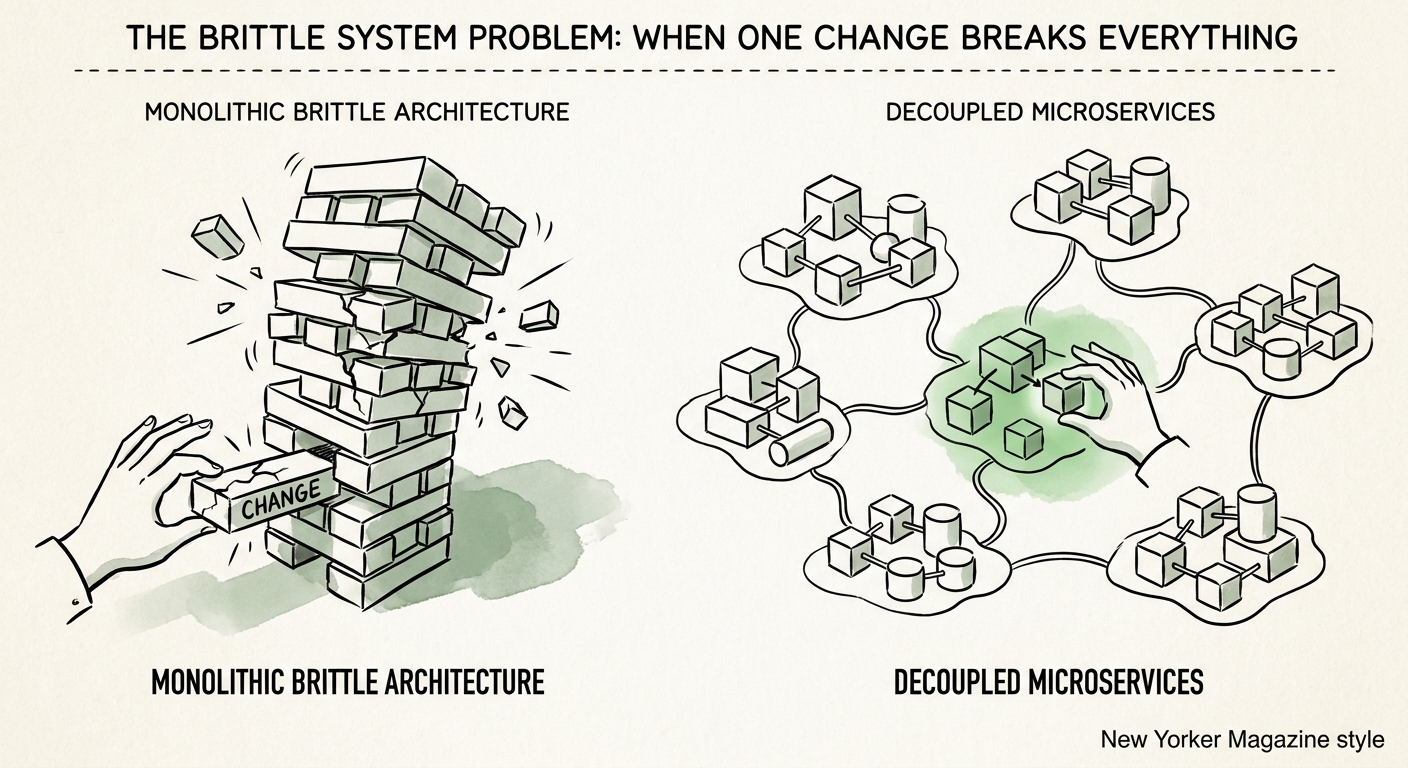
The contrast with decoupled shops is stark. MIT Sloan's research on architecture modularity shows companies with genuinely isolated, service-oriented systems deploy roughly three times faster and absorb 60% fewer severe production regressions — not because their engineers are better, but because a failure in one service stays in that service instead of cascading into billing. Deploy frequency isn't a developer vanity stat. As we lay out in our work on CI/CD pipeline maturity, it's the cleanest leading indicator a buyer has for whether your platform will keep moving after they own it.
How I unwind it without a death-march rewrite
The instinct most founders reach for — freeze the roadmap, do a two-year ground-up rewrite — is the single most reliable way to miss your numbers and get your CTO fired. I never run it. Instead I apply the Strangler Fig pattern: identify the one or two components that change most often and break things most often, carve them out as independent services, and route around the old monolith one boundary at a time. The point isn't architectural purity. It's shrinking the blast radius incrementally so the business never stops shipping while you do it.
The sequence matters more than the tools. Before anyone refactors a line, we wrap the most brittle legacy code in automated tests — a safety net that tells you the instant you've broken a downstream dependency, instead of finding out at $14,500 a minute. Only then do we enforce contracts between modules: if the reporting code needs data the billing code owns, it asks through a versioned API, never by reaching into billing's tables. That one rule — no module touches another's data directly — is what would have kept that dashboard tweak from ever reaching the payment gateway. Make it a hard merge requirement, not a wiki suggestion, and you start collapsing the next ten incidents before they happen.
For a founder pointed at an exit, this is not a nice-to-have. Technical diligence advisors go looking for exactly these cascading dependencies, because they price what they fear: unpredictable R&D cost and stalled innovation after close. Bain's 2026 Technology M&A Report finds acquirers apply an average 22% valuation discount when diligence uncovers severe coupling and brittleness. You can't hide it — a buyer reads the same deploy calendar I do. The work you do now to decouple isn't a developer favor; it's the difference between defending your multiple and watching a fifth of it walk out the door at the table. Start this quarter by instrumenting one painful module with tests and one enforced API contract, and you'll have a concrete improvement to point to before anyone opens a data room.
