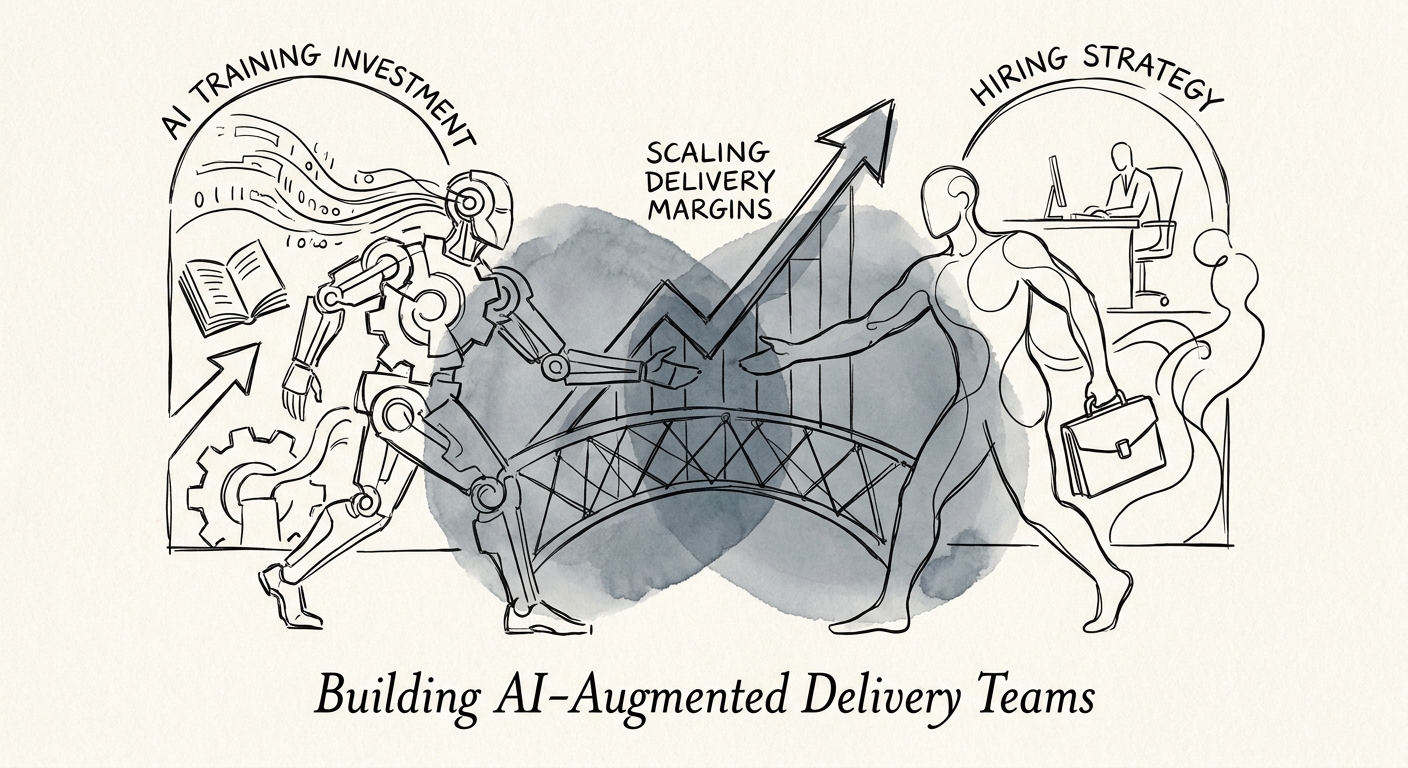
The AI architect couldn't ship, and nobody could say why
Picture a 70-person managed-services firm that just spent six figures recruiting an AI architect off a hot LinkedIn profile. Brilliant credentials, real model depth. Ninety days in, the firm's biggest account, a regulated client mid-migration, is exactly where it was. The architect keeps proposing elegant generative workflows that the delivery lead quietly kills because they cross the client's SOC 2 boundary, or assume a CMDB that was never accurate, or ignore the change-approval ritual that account has run for eight years. The architect isn't wrong about AI. He's missing the only thing that matters here: the work.
This is the trap mid-market IT-services and SaaS practices keep walking into. The industry narrative says you win AI by acquiring net-new talent with machine-learning or prompt-engineering pedigrees. Sometimes that's true. But in a services firm, model knowledge is the cheap, commoditized input. The scarce input is delivery judgment, client context, the legacy decisions nobody documented, the compliance constraints baked into how a stakeholder buys. You can teach a senior delivery lead to drive Copilot or Cursor in a few weeks. You cannot teach a new specialist, in any number of weeks, why the client's ERP was configured the way it was in 2018.
Buying your way out of that gap carries a velocity tax that doesn't show up on the offer letter. You pay recruiter fees, equity, and months of non-billable ramp before the new hire produces anything billable, and that's the best case. The downside case is the one above: an expensive, unintegrated specialist who slows delivery instead of speeding it. If you want the real number, walk through the true cost of a bad tech hire before you post the req. A private-equity buyer running diligence on your firm will. They will not pay a multiple for an AI team that sits adjacent to delivery rather than inside it.
Context is the moat. AI just lets your veterans defend it faster
An LLM with no domain grounding generates plausible code and plausible architecture. What it cannot do on its own is orchestrate a 28,000-seat migration, sequence a carve-out integration, or untangle a decade of technical debt without re-introducing the bug that caused it. Your senior delivery engineers already hold that context. They know which client systems lie to you, which stakeholder signs off on what, and which "quick" change detonates downstream. Hand those people AI augmentation and you collapse the translation layer between business logic and tooling, because there's no translation step at all. The person who knows the SOC 2 boundary is the same person writing the prompt, so the boundary holds from the first generated line instead of surfacing in a review three weeks later.
That's the asset you're actually building: bilingual operators fluent in both your vertical (life-sciences validation, healthcare claims, retail headless commerce, whatever you sell) and the current AI delivery stack. MIT Sloan's 2025 AI Integration Workforce Study found that software-delivery teams prioritizing the upskilling of domain experts over external hiring saw a 35% productivity improvement. The lift comes from removing the handoff, not from adding a smarter person to the org chart.
There's a second return that founders underweight: the people you'd most want to keep are the ones most at risk when their skills stall. Your best senior engineers rarely leave for a 10% bump; they leave when the work stops teaching them anything. Investing in turning them into AI-augmented operators is, functionally, a retention program. Forrester's AI-Augmented Software Development Forecast shows that firms committed to continuous AI upskilling reduce voluntary attrition among senior technical staff, which is precisely the cohort whose departure resets a client relationship to zero. Keep them, and you also sidestep the recruiting drag in our fully-loaded recruiting costs and velocity tax benchmarks, leaving that cash on the balance sheet where it helps your multiple.
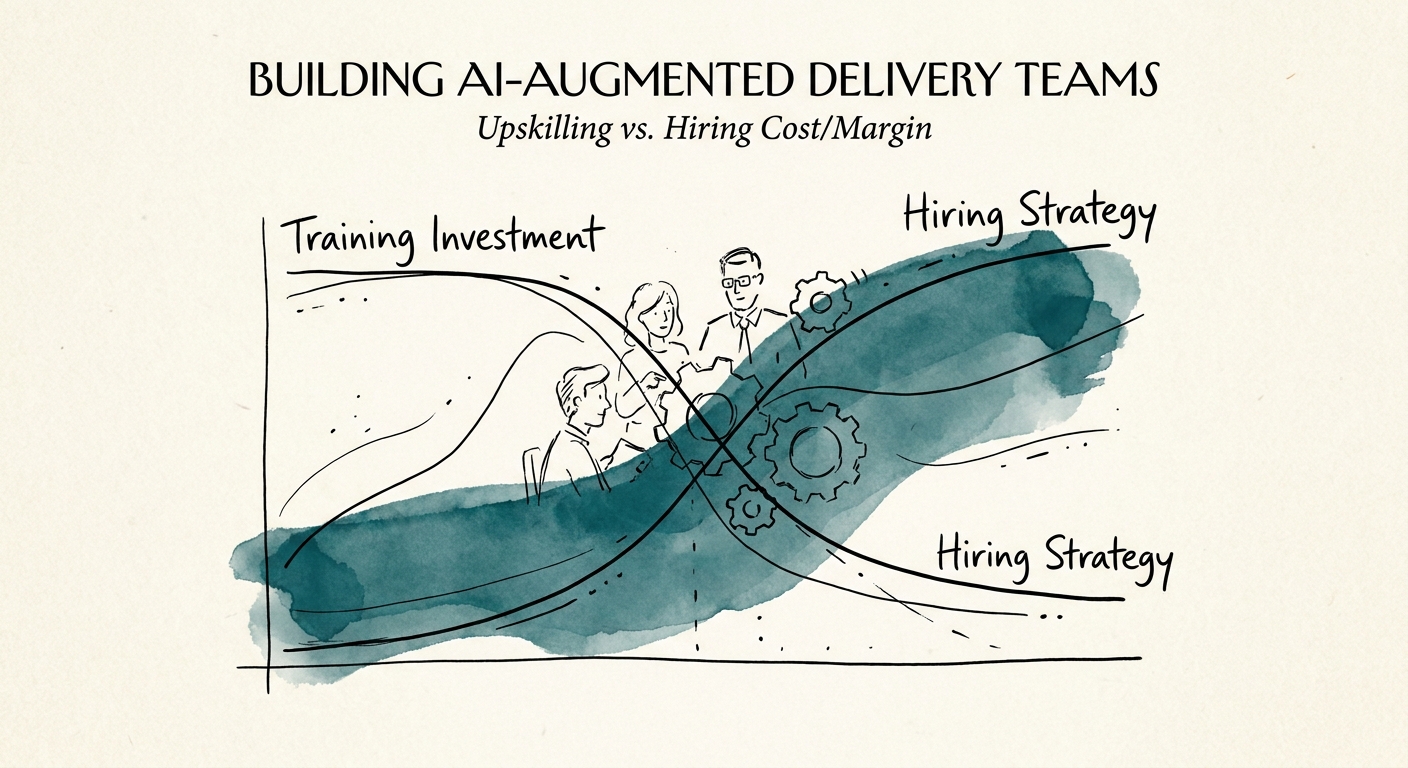
What to do Monday: a one-quarter, measurable enablement plan
Stop treating AI as a specialized role to recruit for and start treating it as a standard delivery competency, no more exotic than version control or sprint hygiene. Concretely, for one quarter: carve out 10% of billable capacity for formal, paid upskilling. Not weekends, not "go learn Copilot on your own time." Real protected hours, on the clock. Then pick your force multipliers off the bench, the senior architects who already command respect and lean toward new tooling, and arm them first. Buy the enterprise licenses, defend their calendar, and have them run a weekly working session where they demo one concrete win: the data-mapping task AI cut from a day to an hour, the integration test it scaffolded. Adoption spreads because a trusted peer showed it beat the old way, not because a memo told them to.
Set the bar at the pipeline level so the gains compound: AI-assisted code review and test generation wired into CI/CD, with senior engineers owning the prompt and review architecture rather than offloading judgment to the model. The leadership data backs the priority. PwC's 2024 AI Business Survey reports that 68% of enterprise CEOs name internal AI literacy, not a shortage of specialized AI engineers, as their main bottleneck to scaling operating margins. And EY's 2024 CEO Outlook Pulse Survey found that companies embedding AI training directly into core delivery lines realize 3x higher return on technology investment than those running isolated AI centers of excellence. The pattern is consistent: embedded beats adjacent.
Then watch the 90-day window. If enablement is working, utilization, cycle time, or delivery-quality metrics move; if they don't, you tune the cohort or the curriculum, not the headcount plan. The point of the experiment is to generate evidence a buyer will respect, that your delivery model is scalable, efficient, and carries proprietary, codified workflows rather than rented expertise. You still hire, of course, but hire for adaptability using the 92% Hiring Accuracy Framework for Scaling Tech Teams, and point the bulk of your capital at the people who already know the work. Train them, codify what they do, and make AI part of how delivery quality gets defined.
