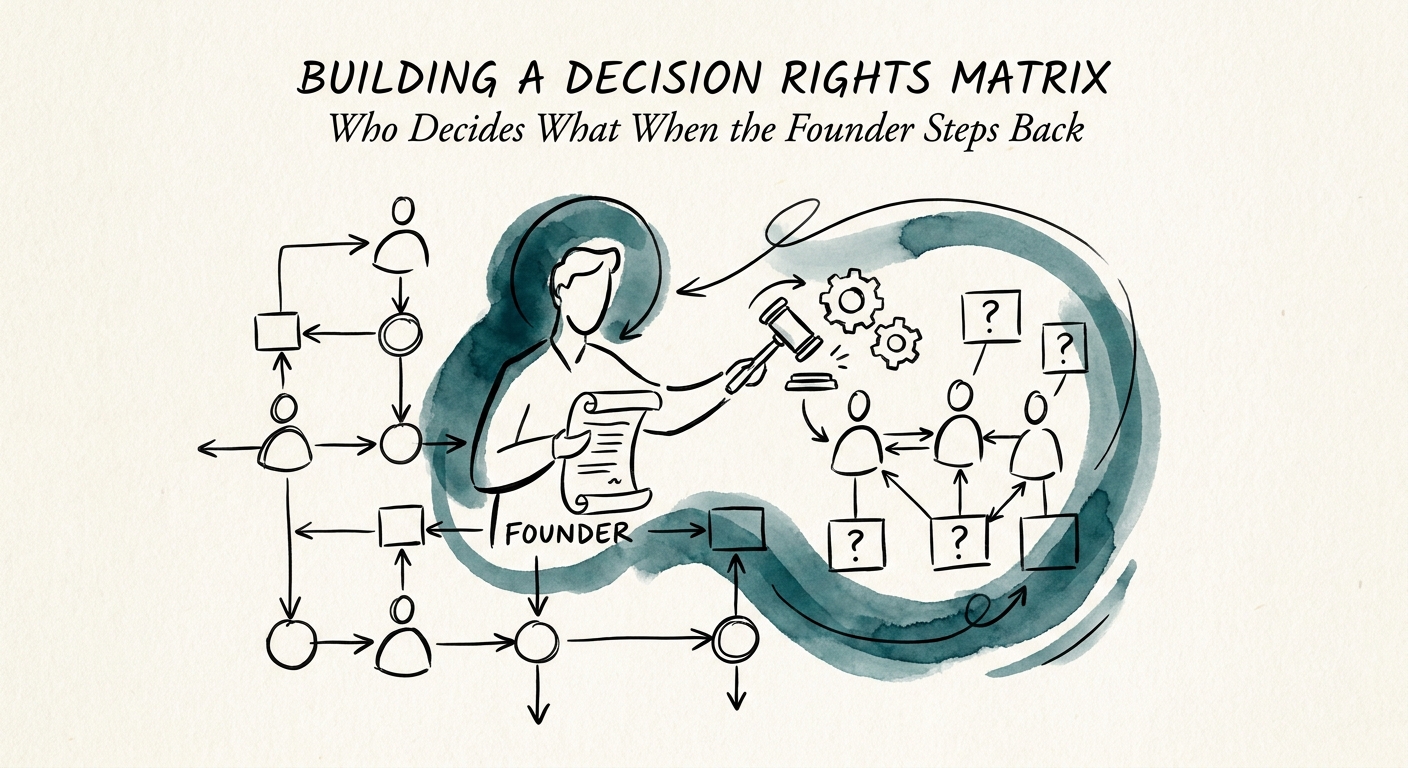
The Slack message that costs you $2.4 million a year
It is a Tuesday at a 140-person B2B SaaS company that closed its Series C last quarter. The new VP of Engineering needs to swap an observability vendor — a $48,000 annual line item, already in her budget, well inside her remit. She types it up. Then, before hitting send to procurement, she opens a second window and DMs the founder: "Quick gut check before I sign?" The founder is in a board prep session. The message sits for three days. The renewal lapses. The team spends a weekend on a workaround.
Multiply that single hesitation across every VP, every week, and you arrive at the number we keep measuring inside scaling SaaS orgs: roughly $2.4 million a year evaporating into delayed execution and duplicated effort — not because anyone is incompetent, but because nobody is sure they are allowed to act. The transition from founder-led heroics to executive-led operations is not a hiring problem you solve by buying competent VPs. It is a violent rewrite of how your company decides things and moves money. If you never codify who holds the pen, your freshly minted leadership team will spend their first six months auditioning for authority they technically already have.
The shadow veto is the specific killer
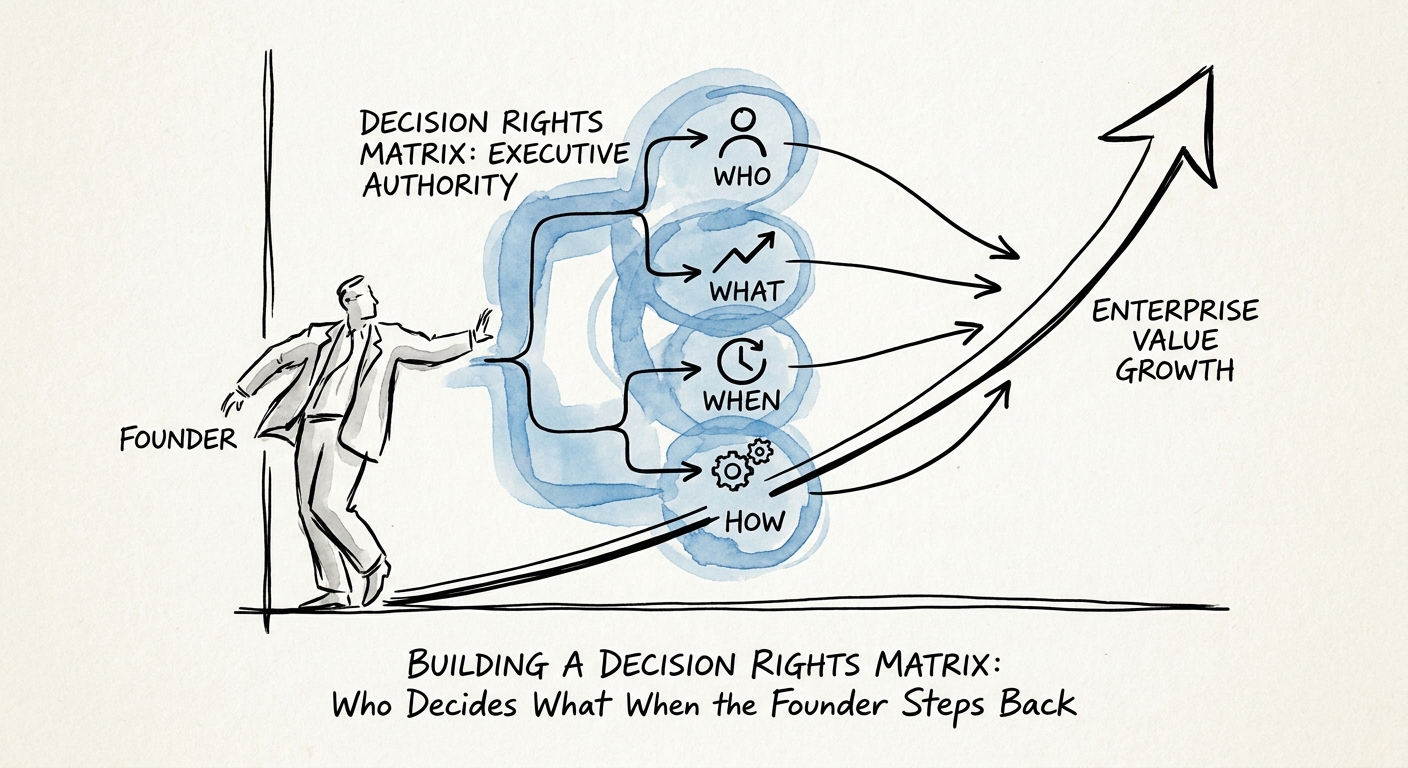
In the last three engagements where we pulled technical founders out of daily operations, the same pattern surfaced: the founder grants the title — CRO, COO, VP Eng — and then quietly keeps an informal veto over budget and senior hires. That informal veto is the entire disease. Gartner's 2026 Founder Succession and Executive Transition Report found that scaling organizations operating without explicit decision-making matrices suffer a 28% drop in enterprise value growth across their first 18 months of executive transition. Ambiguity does not feel expensive in the moment. It feels like caution. It is actually a tax on velocity, charged daily.
The fix is not a values workshop. It is a written matrix that names, for every recurring decision, exactly who decides — and removes the founder's name from most of those rows. Bain & Company's RAPID decision rights framework benchmarks show that organizations that rigorously clarify who decides execute strategic initiatives 3.5x faster than those running on consensus or founder intuition. The gap between a stalled Series B and a company that compounds is frequently nothing more sophisticated than a one-page document that says, in writing, "the founder is informed, not consulted."
What a row in the matrix actually looks like
Most teams build the matrix wrong because they keep it abstract — "Engineering owns engineering decisions." That sentence resolves nothing the next time a Tuesday DM goes out. A usable matrix is brutally specific: it names the decision, the dollar or scope threshold, the single accountable owner, and who gets a vote versus who merely gets a heads-up. Borrowing RAPID's discipline, the only role that matters in a dispute is the one person with the unappealable authority to execute. Everyone else inputs or recommends. You cannot assign "co-decision" rights to two VPs and call it collaboration — in a leadership layer, shared accountability is no accountability, and you will discover this the first time something breaks and both of them point sideways.
Here is what three real rows look like for a Series B/C SaaS org. Vendor and tooling spend: the VP of Engineering has final authority on any technology purchase under $100,000 that sits inside her approved budget; the founder is informed via the monthly ops review, not consulted in advance. Sales compensation plans: the CRO has absolute authority to set and revise comp, provided the plan clears the board-approved gross-margin floor; nobody else signs. Senior hires (Director and below): the functional VP decides and owns the outcome; the founder may interview but does not hold a veto. Product roadmap sequencing within the quarter: the VP of Product decides; the founder sets the annual thesis, then steps off the steering wheel.
The two thresholds founders fight hardest to keep
The roadmap and senior hires are exactly where founders refuse to let go, and it is the root of the founder delegation paradox: the founder believes their taste is the moat, so relinquishing those two columns feels like negligence. Harvard Business Review's longitudinal study on founder extraction puts hard numbers on it — 73% of founders fatally struggle to relinquish tactical control without a rigidly documented authorization system to lean on. The documentation is not bureaucracy; it is the crutch that makes letting go survivable, because the founder can point to the matrix instead of relitigating every call from instinct.
And pushing authority down is not soft culture work — it is a P&L lever. McKinsey's 2025 analysis on organizational decision-making velocity shows that moving definitive decision authority down by a single management tier yields a 14% improvement in EBITDA over twelve months. The mechanism is unglamorous: when a marketing budget no longer waits for the founder to finish closing a whale or running a raise, the latency simply disappears from the system, and latency is where margin goes to die.
How a buyer finds your shadow veto in 20 minutes
Private equity buyers and strategic acquirers are not buying your product. They are buying the cash flows your operating engine produces — and pricing the risk that the engine stops the day the founder takes a vacation. They will find your shadow governance during operational diligence, and they barely have to dig. The classic move: they sit down with your CRO and ask, plainly, "Walk me through how the 2026 pricing change got finalized." They are not listening for the answer. They are listening for whether the CRO says "I decided, here's my reasoning" or flinches and says "we aligned with the founder on it." One of those answers protects your multiple. The other one funds the buyer's negotiating leverage.
Make the matrix a living instrument, not a Confluence fossil
A decision rights matrix that lives in a forgotten Confluence page survives no diligence and saves no Tuesdays. It has to be load-bearing. We require it inside the quarterly business review: every time a decision visibly bottlenecks, the matrix goes on the table and gets interrogated. Was the threshold ambiguous? Did the founder reach past their column? Did a VP punt a call they were paid to own? That standing audit is the spine of the 12-month journey from founder dependency to scalable operations, and the financial stakes are explicit: PwC's 2026 Post-Merger Governance Benchmarks report that PE firms apply an automatic 15% to 25% valuation discount when a founder dependency diagnostic exposes a CEO holding undocumented veto power over core divisional operations.
Here is what you can do this week. Pull your last quarter of decisions that stalled waiting for you. For each one, write a single row: the decision, the threshold, the one name who should own it, and whether you get a vote or a notification. Then hand those rows to the owners and say, out loud, "I'm informed, not consulted — and I'm not coming back to override you." Empower them to make a $48,000 mistake and answer for the outcome. That sentence, repeated until it is true, is the only mechanism that turns a founder from the bottleneck into the strategic asset a buyer will pay full price for. Codify the rules of engagement now, or keep paying the velocity tax one Slack message at a time.
