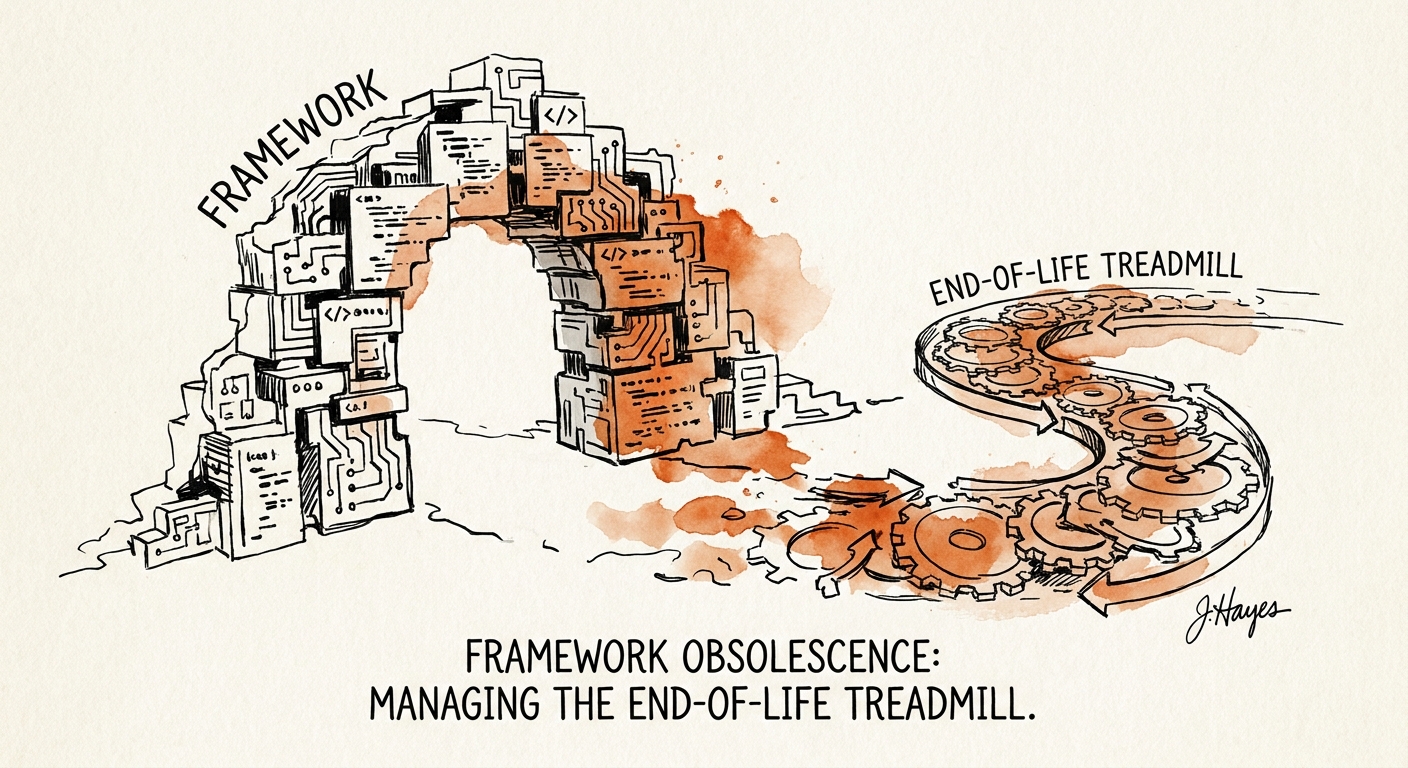
The framework didn't break. The support did.
Say a 60-person B2B SaaS company runs a customer-facing admin console built on AngularJS. The app works. It's been working for years. Then a security researcher publishes a cross-site-scripting bypass, and the team goes looking for the patch — only to discover there isn't one, and there never will be. AngularJS hit its terminal date and is no longer maintained; the AngularJS version support status spells out exactly when the lights went off. The code didn't change. The risk profile did, overnight, for free, without anyone touching the repo.
That's the trap of the end-of-life treadmill in a software business: obsolescence is invisible until the day it isn't, and by then it shows up as a CVE you can't close, a candidate who won't take the job, or a diligence question you can't answer cleanly. The reason it festers is org-chart, not technical. Engineering files it under "tech we'd like to replace someday." Finance never sees it because it doesn't have a line item. So it sits — until a buyer's diligence team or a customer's security questionnaire forces the conversation on someone else's timeline.
The first move costs almost nothing: a single end-of-life register. One row per dependency, with the framework, the product surface it powers, a named owner, current support status, the replacement path, and a date by which it becomes a real problem. This is the maintenance discipline the NIST Secure Software Development Framework assumes you already have — protecting software after release, not just shipping it. Most companies under 100 people don't have this list. Building it is a half-day exercise that turns a vague anxiety into a finite, rankable problem.
Where the AI migration pitch goes sideways
The seductive pitch right now: point a coding agent at your dead AngularJS app, say "migrate this to a modern framework," and walk away. It will produce something. It will compile. And for a customer-facing surface in a SaaS product, that's precisely the wrong place to trust an unsupervised rewrite, because the failure mode isn't a broken build — it's a subtle behavioral drift in a screen a paying customer uses every day, shipped without anyone noticing what changed.
Use AI where it earns its keep: cataloging every call site of a deprecated API across the codebase, drafting the migration test harness, and grinding through mechanical syntax conversion. Keep humans on the parts where the framework's behavior was load-bearing — the auth flow, the data-mutation paths, the bits where AngularJS's two-way binding quietly papered over a race condition you've forgotten about. The NIST AI Risk Management Framework gives the right discipline: map what the system actually does, measure where the migration introduces risk, manage the controls, and keep a named human accountable for the output.
Then sequence the work in three honest buckets. Now: anything with an open, exploitable security exposure and no patch path — that's not a roadmap item, it's a fire. Next: dependencies with a known support cliff inside the next two to four quarters, scheduled around real customer commitments so a migration sprint doesn't collide with a contractual delivery. Later: architectural simplification that reduces how many of these landmines you're carrying at all. Each bucket should carry a capacity cost, which is why this work belongs in the same conversation as technical debt as a percentage of engineering capacity — until you've priced the migration in engineering-weeks, "we should fix that" stays a wish, not a plan.
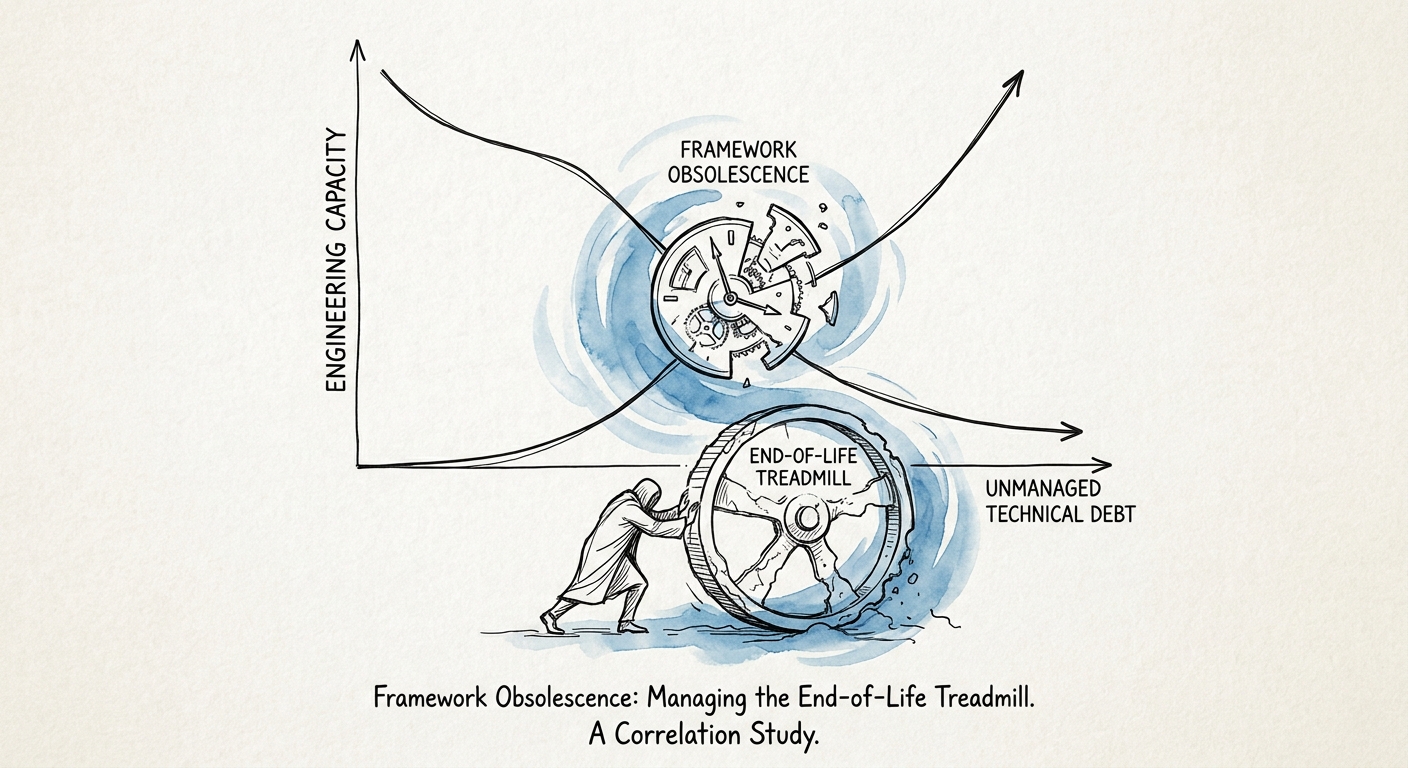
Fix the policy, not just the framework
Here's the part teams skip: you finish the AngularJS migration, everyone exhales, and four years later you're having the identical conversation about whatever you migrated to. The treadmill resets because nothing changed about how the company adopts and retires dependencies. The durable output of the first migration isn't the new framework — it's the policy that stops the next one from going dark unnoticed.
That policy is short. New runtime dependencies get a named owner and a support-horizon check before they go in. The end-of-life register gets reviewed on a fixed cadence, not when a CVE forces it. And anything crossing into "support ends within a year" automatically becomes a roadmap item with capacity attached. The CISA Secure by Design guidance argues for exactly this posture — building maintainability in deliberately instead of reaching for it reactively after something breaks.
For a SaaS company heading toward a raise or an exit, this is also the difference between a clean diligence and a discount. A buyer's technical reviewer will find your dead AngularJS dependency in an afternoon. The question is whether they find it alongside an inventory, a remediation plan, a test-coverage figure, and an owner's name — a governed program they can underwrite — or whether they find it cold and start subtracting from the offer. If your stack has a frozen framework version anywhere near a customer-facing surface, build the register this week and talk through the recovery plan before someone else sets the deadline for you.