The 92% activation rate that meant nothing
Picture a 140-person B2B SaaS company. They rolled out an AI coding assistant to every engineer and a summarization tool to the whole support org. Six months in, the vendor dashboard is glowing: 92% of seats activated, thousands of suggestions accepted, daily active usage climbing. The CFO sees the bill. The CTO sees the dashboard. Nobody can answer the only question that matters: did anything ship faster, or did support resolve tickets sooner?
That gap is the whole problem. A seat activation is a measure of curiosity, not change. An engineer can accept fifty AI completions a day and the team's release cadence can stay exactly where it was in January, because the actual bottleneck was code review latency and a flaky staging environment — neither of which an autocomplete touches. Gartner's forecast that over 40% of agentic AI projects will be canceled by 2027 is not a story about bad models. It is a story about teams that measured usage instead of outcomes and ran out of patience when the usage didn't convert to anything.
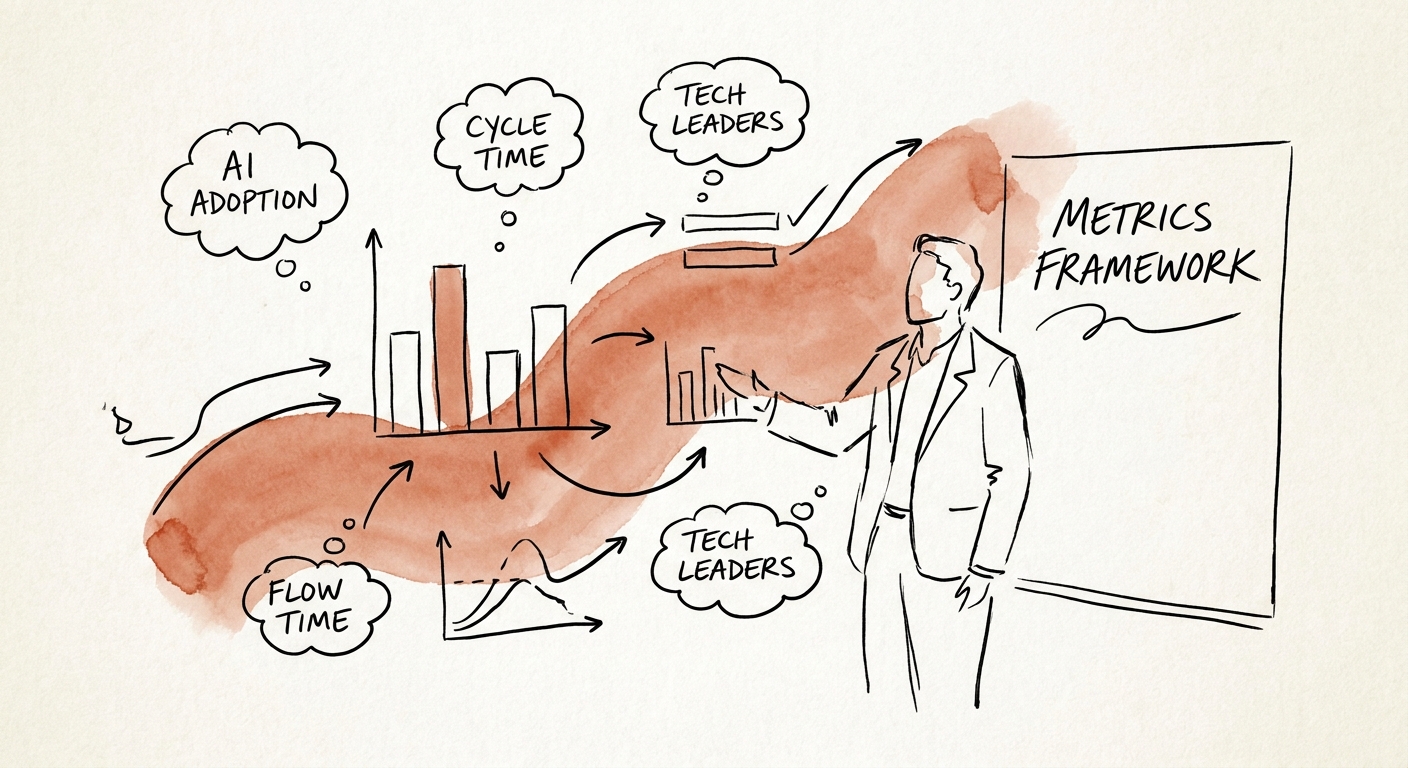
So flip the starting question. Don't ask "are people using the tool?" Ask "which specific workflow was this supposed to change, and who owns the number that proves it?" In a SaaS shop that means naming things precisely: PR cycle time on the platform team, first-response time in tier-1 support, the hours it takes a sales engineer to turn a discovery call into a scoped technical proposal. Vendor telemetry stays in the stack — it tells you whether a workflow even has a chance of improving — but it sits at the bottom, as an input, never as the headline. The headline is a number your leadership team already trusts and already reviews.
Five numbers per workflow — and the trap each one catches
For every named workflow, track five things. Each one exists to catch a specific way the rollout can quietly fail.
Penetration: of the eligible instances of this workflow, how many actually ran through the AI-supported path? If only 20% of PRs used the assistant's review step, you have a behavior problem, not a tooling problem — and no amount of cycle-time data is trustworthy yet. Cycle time: request to usable output. This is where the autocomplete illusion dies. If suggestion-acceptance is high but PR-merge time is flat, the assistant is helping the typing and ignoring the constraint. Rework rate: how often does the AI-touched output get sent back, reverted, or rewritten? A support team that drafts replies in seconds but triggers a 30% follow-up-ticket rate has moved the work, not removed it. Review reliability: is the human control point actually firing? When AI output looks polished, the dangerous failure mode is that a reviewer rubber-stamps a confidently wrong test or a hallucinated API in a customer-facing doc. Business result: the number leadership already watches — merge frequency, CSAT, tickets resolved per agent, proposal turnaround.
The discipline that makes this real is the baseline. Before the pilot starts, measure the current state for thirty days: how long does tier-1 first response take today, what's the current PR cycle time, how often does a sales-engineering proposal need a second round? Write it down before anyone is rooting for the tool. Then hold the AI-supported version to the same yardstick. McKinsey's State of AI research and Deloitte's State of AI report both keep landing on the same uncomfortable point: the companies seeing returns are the ones who scoped a measurable process and rewired it, not the ones who handed out licenses and hoped. The RSM middle-market survey shows the same split in companies your size. The polish of AI output is exactly why the measurement matters more, not less — it's easy to mistake a clean draft for a solved problem.
Make the review produce a decision, not a slide
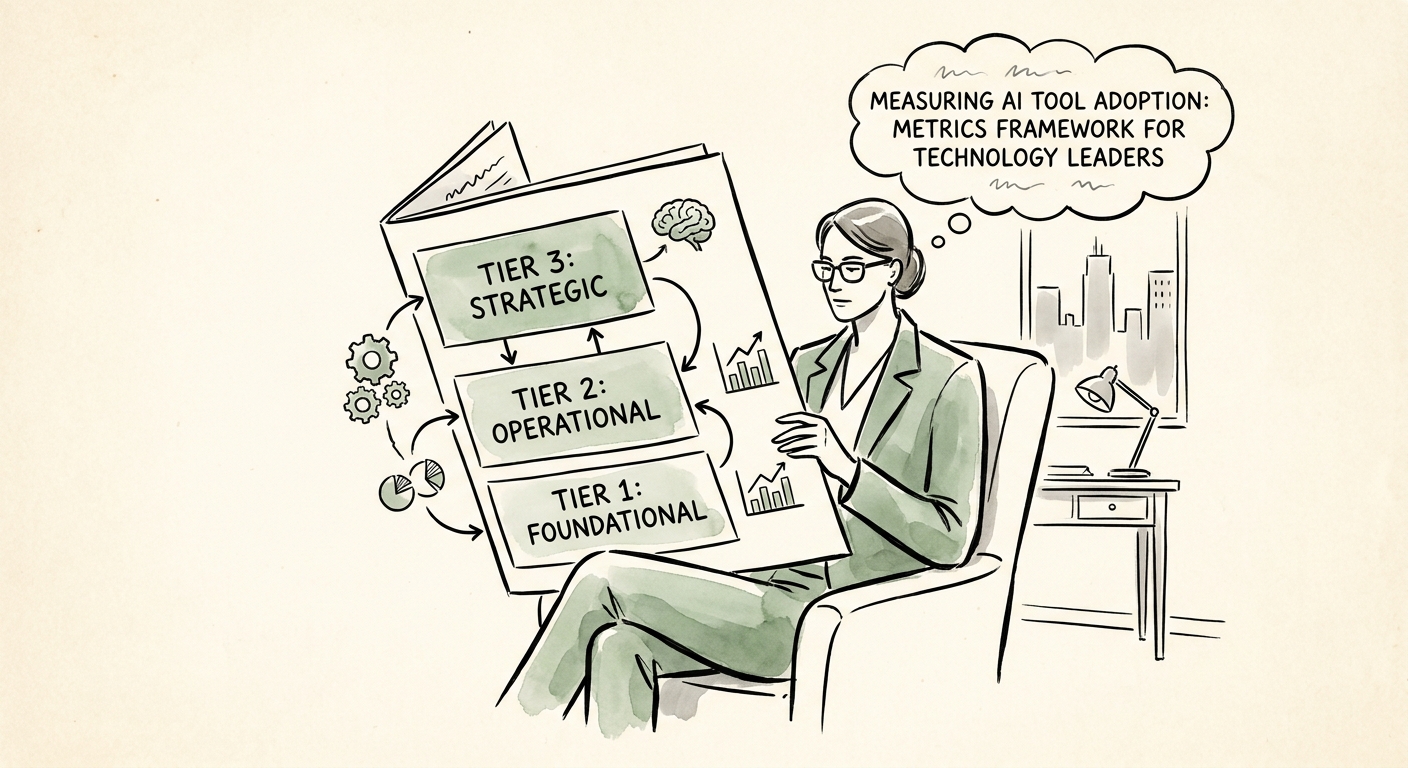
An adoption review should end with a verb: keep, expand, fix, or kill. Read the five numbers as a diagnostic grid. High penetration, flat business result? The workflow you picked wasn't the constraint — your release cadence was gated downstream, and an AI assistant on the upstream step was never going to move it. Low penetration, high-value workflow? Don't blame the model; inspect training, access permissions, source-data quality, and whether the engineering manager actually expects people to use it. Cycle time improves but rework climbs? You've traded speed for risk, so tighten the review rule before you expand. Output quality wobbles? The fix is usually source governance — what the tool is allowed to read — not a better prompt.
The most valuable output of this framework is permission to stop. Some bets are too vague, too dependent on messy data, or too far from any number your team watches. Sidelining those early isn't failure — it's the thing that keeps the other bets funded. A SaaS leadership team that rewards an engineering lead for killing a weak AI pilot at week six, with evidence, is a team that will still have AI budget at month twelve.
Keep the report to one line per workflow: workflow, owner, baseline, AI-supported process, review rule, result, next decision. That's enough for a CTO and a CFO to tell whether AI has become an operating capability or is still a pile of disconnected tool trials. If you're choosing your first measured workflow, score the candidates with the AI use-case scoring model first; pressure-test a mainly-financial case with the AI ROI Calculator; and if you need a wider read before a broad rollout, run the AI Opportunity Score. The goal Monday morning is simple: pick one workflow, write down its baseline before you touch the tool.
