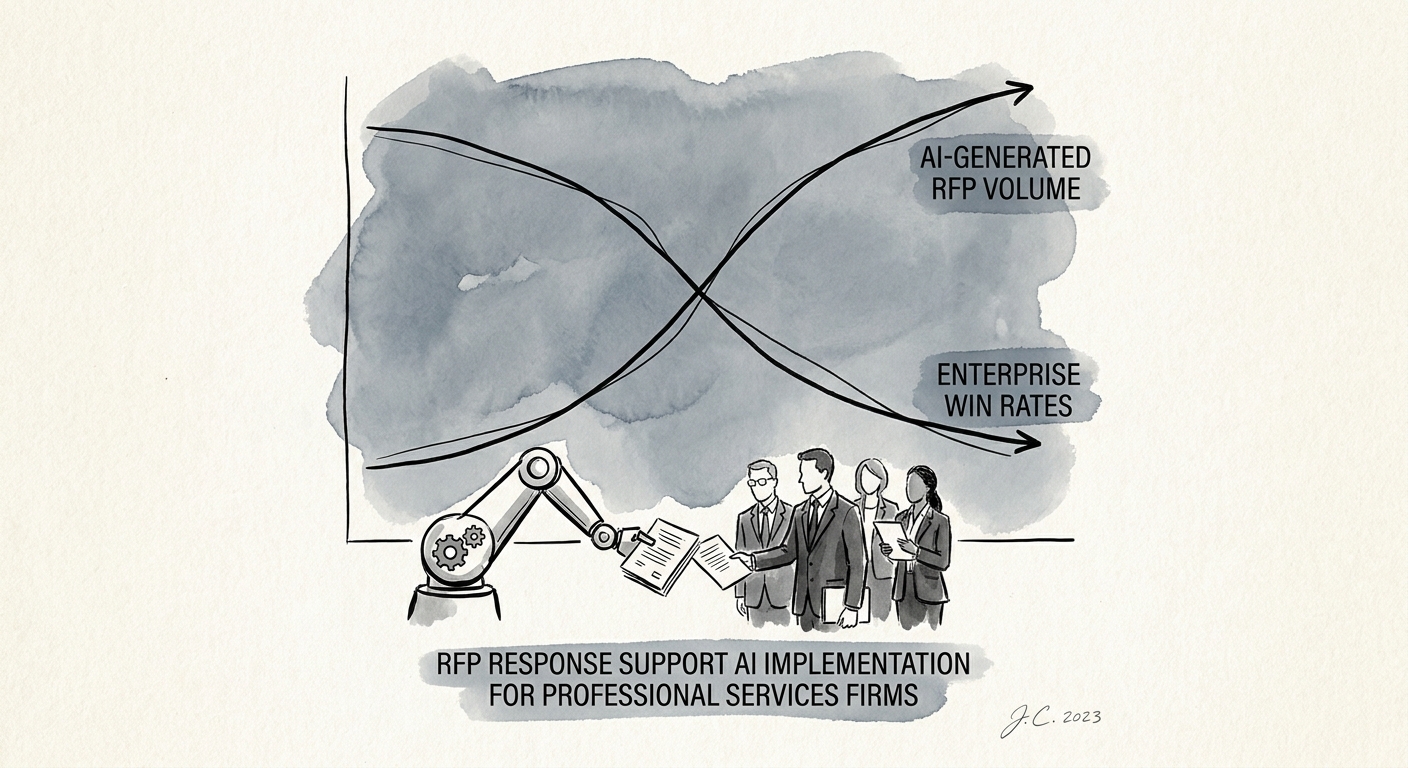
The 200-page RFP lands on a Thursday, due next Friday
Here's the scene every proposal lead in a professional services firm knows. A qualified opportunity drops a procurement document with 140 mandatory requirements, a compliance matrix, three reference templates, and a hard deadline that overlaps with two other live bids. The first 60% of the work is not strategy. It's archaeology: digging through past proposals for the org chart you already built, the methodology section you already wrote, the SOC 2 attestation language, the case study that fits this vertical. Your senior sellers — the people who should be shaping win themes and pricing — are instead copy-pasting boilerplate at 9pm.
That archaeology is exactly where AI earns its keep, and it's the only place it earns its keep. Both the RSM middle-market AI survey and Deloitte's State of AI in the Enterprise 2026 land on the same point from different angles: AI returns value when it's wired into a governed production workflow with a named owner and a measured outcome, not when it's a clever drafting toy bolted onto an existing mess.
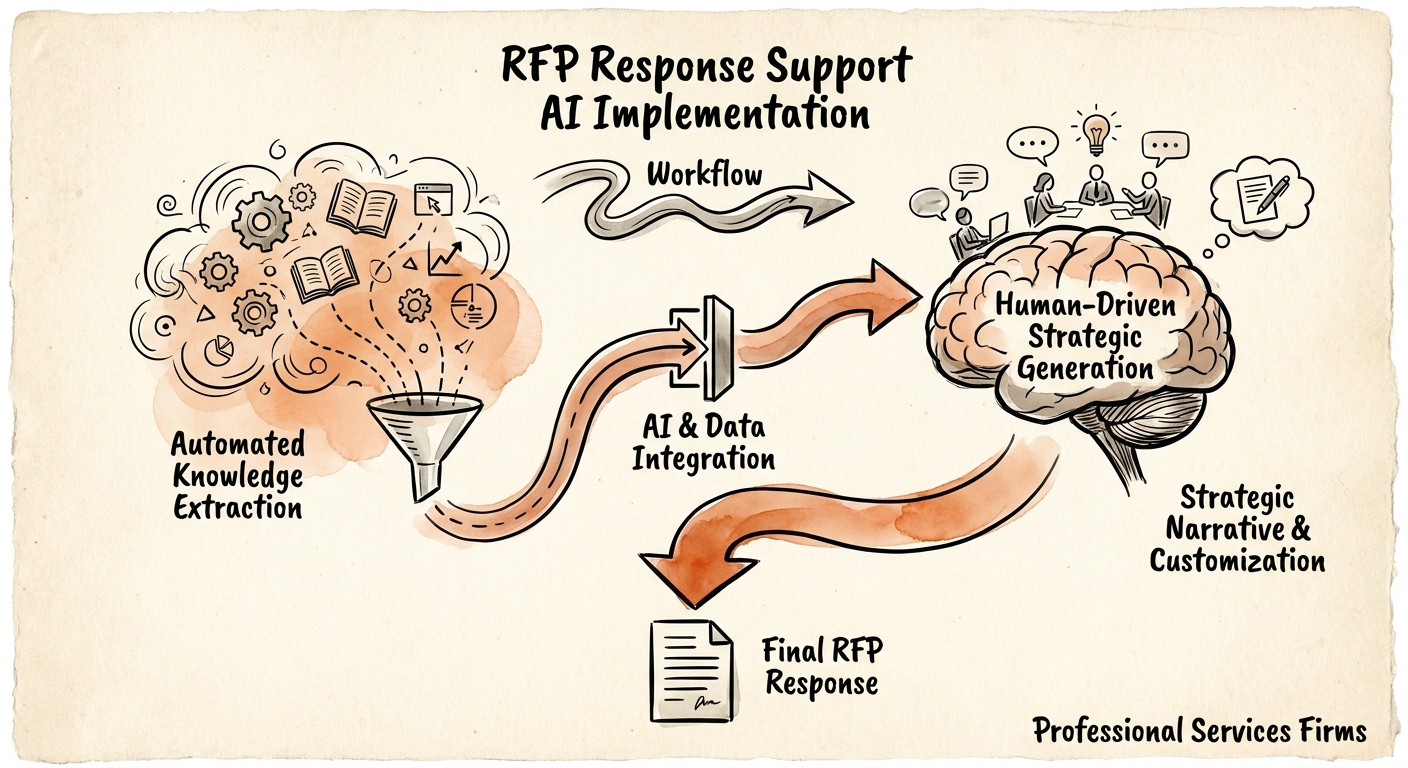
So draw the line clearly. AI assembles: it retrieves the right prior answer, drafts the requirement responses that are genuinely repetitive, maps your content against the compliance matrix, and flags the requirements you have no good answer for. Humans decide: which deals to chase, how to price them, what risk you'll accept in the SOW, and what specific promise you're willing to put in front of this buyer's evaluation committee. If you want the retrieval layer to actually work, organize the proposal archive first — a model can only resurface answers that were stored and tagged in a way it can find.
The dangerous draft is the one that sounds right and isn't
RFP responses are a uniquely hazardous place to let a model improvise, because the failure mode is invisible until it costs you. A generic chatbot will happily write "we have delivered 40+ engagements in your sector" or "our solution is fully HIPAA-compliant" because that phrasing pattern-matches a thousand winning proposals it has seen. The problem is that those are contractual representations a procurement officer can hold you to — and you may have done 12 engagements, not 40, and your compliance posture may have caveats. A confident, plausible, slightly-wrong sentence is worse in a bid than a blank field, because the blank field gets caught in review and the confident sentence sails through.
That's why proposal AI is a controls problem before it's a productivity problem. Your responses touch confidential client requirements, your own pricing logic, reference customers under NDA, and sometimes regulated evidence like security attestations. The NIST AI Risk Management Framework and CISA's AI Data Security Best Practices both point to the concrete guardrails this calls for: the model draws only from an approved, current source library, access is scoped by role, every generation is logged, and a named reviewer owns sign-off. Before any of that, confirm the enterprise privacy and admin controls of whatever environment processes the content — OpenAI's enterprise privacy terms are the kind of baseline to check, so a client's confidential requirements don't quietly become training data or leak across deal teams.
Practically, that means three review gates before a response leaves the firm: a factual-claims gate (every number and credential traces to a verifiable source), a client-specificity gate (this reads like it was written for them, not pasted from the last bid), and a partner gate (someone accountable for the relationship has read it and will defend it). Feed those gates with a disciplined intake step — the document-intake pattern for professional services is the right front door for getting RFP source material in clean.
Track win rate, not words per hour
The seductive metric here is drafting time, and it's the wrong one. Cutting a proposal from 30 hours to 12 looks great on a dashboard and means nothing if your win rate doesn't move — or worse, if faster generic answers actually lower it because evaluators can smell boilerplate. The metrics that matter are downstream: shortlist rate and win rate on AI-assisted bids versus your baseline, the volume of late-stage rewrites partners have to make (a proxy for first-draft trust), how much of senior sellers' reclaimed hours went into win themes and pricing strategy rather than just being freed up and idle, and what your win/loss debriefs say about answer quality.
Start narrow enough that you can actually read the signal. Pick one proposal type you bid often — say, a recurring managed-services RFP or a standard statement-of-qualifications — give it one owner, one curated evidence library, and one review path. Run it for a quarter. If reuse goes up and last-minute partner rewrites go down on that one type, you've earned the right to expand to the next. If they don't, you've learned something cheap instead of rolling a broken workflow across every deal team.
Hold the whole thing to an honest scoreboard so the time savings don't turn into invented ROI — measuring AI ROI without fake savings is the discipline that keeps a proposal-AI rollout from becoming a number that looks good and a win rate that doesn't budge. If you want a sequenced way to stand all of this up, that's what the AI roadmap is for.