The deal that kills your quarter has a blank next-step field
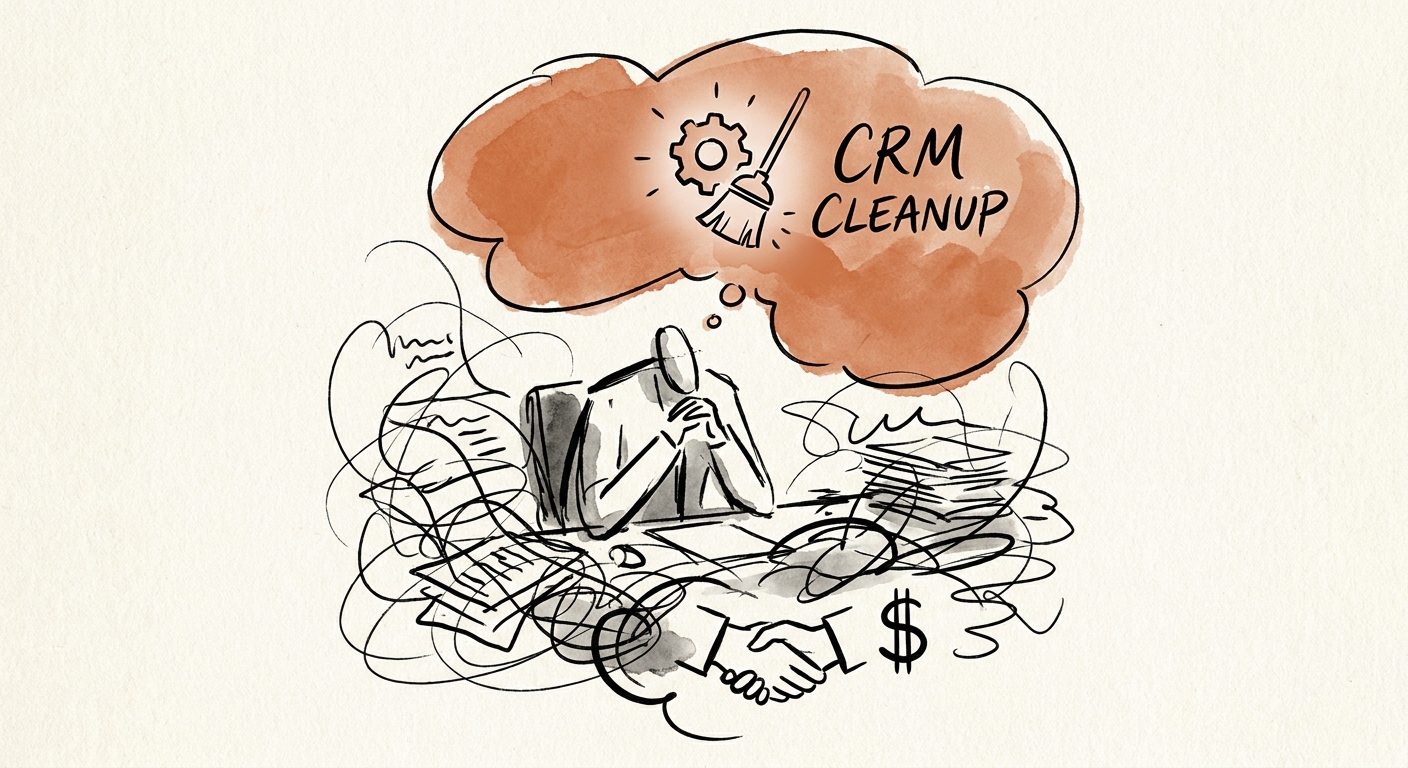
Picture the Monday pipeline review. A rep walks you through six "commit" deals. Five have a clear next step and a date. The sixth has been sitting at 80% for nine weeks, the last logged activity is an email the rep sent, and the next-step field just says "follow up." That's the deal that slips. Not because the rep is dishonest, but because nobody made the CRM tell the truth, and AI built on top of that record will confidently forecast the slip as a win.
This is why so many sales teams reach for the wrong first AI project. They want prospecting bots and predictive forecasting because those feel like growth. But both of those tools read from your account, contact, and opportunity records, and the Salesforce State of Sales research keeps surfacing the same gap: reps lose hours to admin and bad data, and AI-supported selling only pays off when the underlying records are good enough for a manager to trust. Point an AI at a CRM where stale close dates are the norm and you don't get insight. You get faster wrong answers.
The Deloitte State of AI in the Enterprise 2026 names the reason value shows up for some teams and not others: the winners redesign the workflow around the tool instead of bolting the tool onto a broken workflow. In sales, the workflow that matters isn't the model output. It's the deal review. Clean that first, and every later AI bet has a foundation. Skip it, and you're automating the part where your reps were already guessing.
Clean the fields a rep would defend in a deal review, not the empty ones
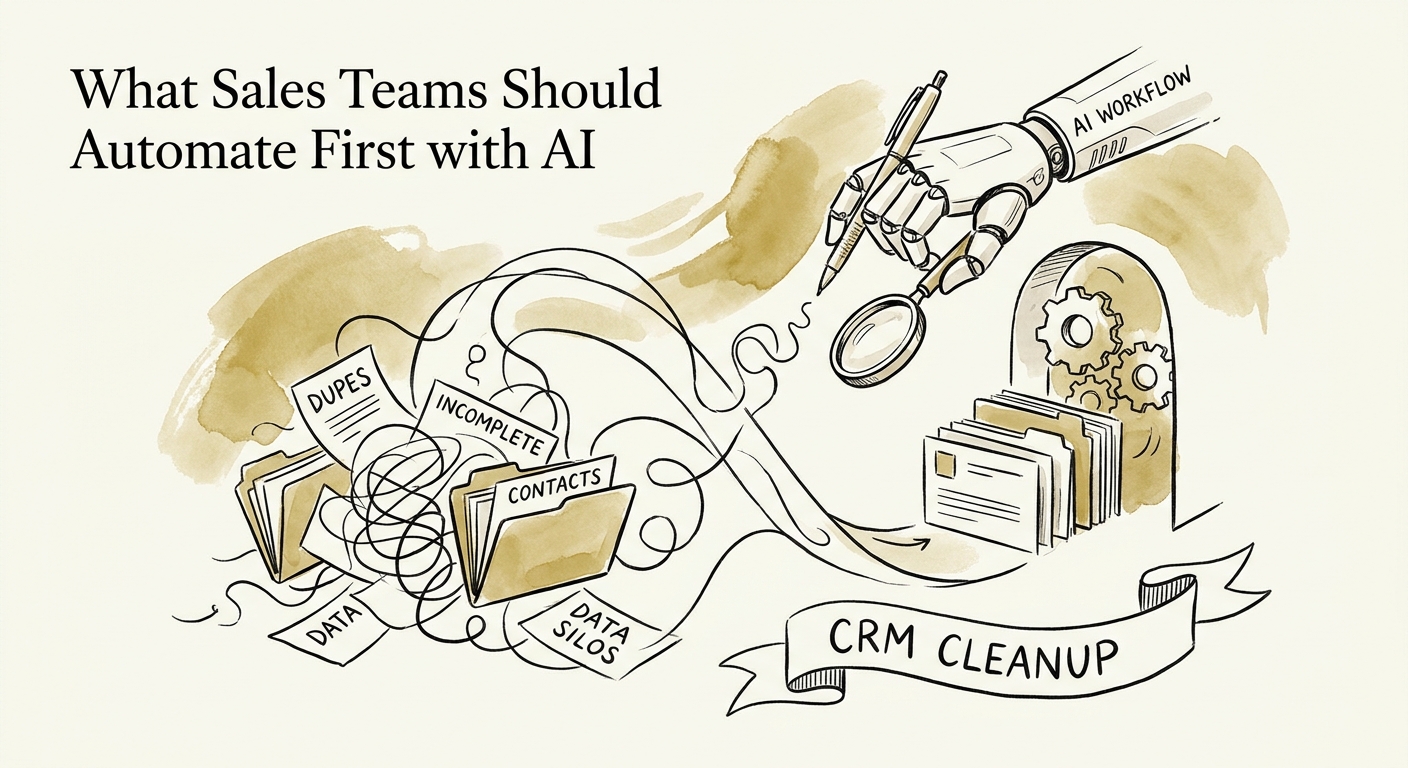
Most "CRM hygiene" projects chase completeness: fill every blank, dedupe every account, standardize every industry code. That's busywork that looks like progress. The fields worth an AI's attention are the ones that change what a manager does on Monday. There are five, and they're specific to how deals actually move:
- Next step — not "follow up," but a verifiable action with an owner and a date. An AI can flag every open opportunity where this is blank, vague, or older than the last activity.
- Decision role on the primary contact — is this person the economic buyer, a champion, or a coach? A deal with no mapped economic buyer at 80% is a fiction, and AI can surface those by cross-referencing title, activity, and stage.
- Close-risk reason — when a deal is flagged at-risk, why? AI can read the activity thread and propose a reason ("no exec engagement in 21 days," "procurement not looped in") for the rep to confirm.
- Stale activity — opportunities where the close date is inside 30 days but the last logged touch is 3+ weeks old. This single rule exposes more slipping deals than any forecasting model.
- Duplicate accounts — the same logo entered three ways, splitting the relationship history. AI is genuinely good at proposing merges; let it propose, not execute.
The pattern that keeps this safe: the AI proposes a correction and routes it to the rep or manager. It never silently rewrites the record. That review step is the whole point, and it's exactly the controlled posture the NIST AI Risk Management Framework describes — a recommendation stays reviewable before it can move the forecast. A weekly manager review where the AI has pre-stacked the questionable deals turns a two-hour ritual of "walk me through your pipeline" into fifteen minutes of "confirm or fix these eleven flags."
And measure the right thing. The win isn't fields touched or a higher "data completeness" percentage — that number rewards box-checking. The win is pipeline movement on the deals the AI flagged: did the at-risk deal get an exec meeting booked, or did it finally get marked lost and free up the rep's time? To keep that business case honest, pair this with CRM cleanup pipeline velocity ROI.
Decide who can see the pricing notes before the AI does
Here's the part sales leaders skip and regret. Your opportunity records aren't just names and stages. They hold discount approvals, competitive intel, renewal-risk notes a CSM typed in a moment of candor, and sometimes a contact's personal mobile. The second you connect an AI workflow to that data, you've created a new path for it to leak — into a prompt, a vendor's logs, or a summary that lands in the wrong inbox. The CISA AI data-security best practices give you the lens: know what's sensitive, scope what the AI can read, and confirm where the data goes before you turn it on, not after.
For a B2B services team, this is a concrete, one-afternoon decision. Say a 40-person agency turns on CRM cleanup. The fix is usually to fence off the free-text notes and pricing fields from the cleanup workflow at first, prove the loop works on the structural fields (next step, decision role, stale activity), then decide deliberately whether the AI gets to touch the sensitive layer. You lose nothing by sequencing it that way, and you avoid the meeting where someone asks why margin notes showed up in a model's output.
Once that first loop is humming — flags proposed, reviewed weekly, slipping deals surfaced before they slip — you've earned the right to the things you actually wanted. Lead routing, automated account research, proposal drafting, renewal-risk scoring: every one of them reads from the CRM, and every one is more reliable because you cleaned the five fields first. Start there this week, and when you're ready to sequence the rest, that's what the AI roadmap is for.