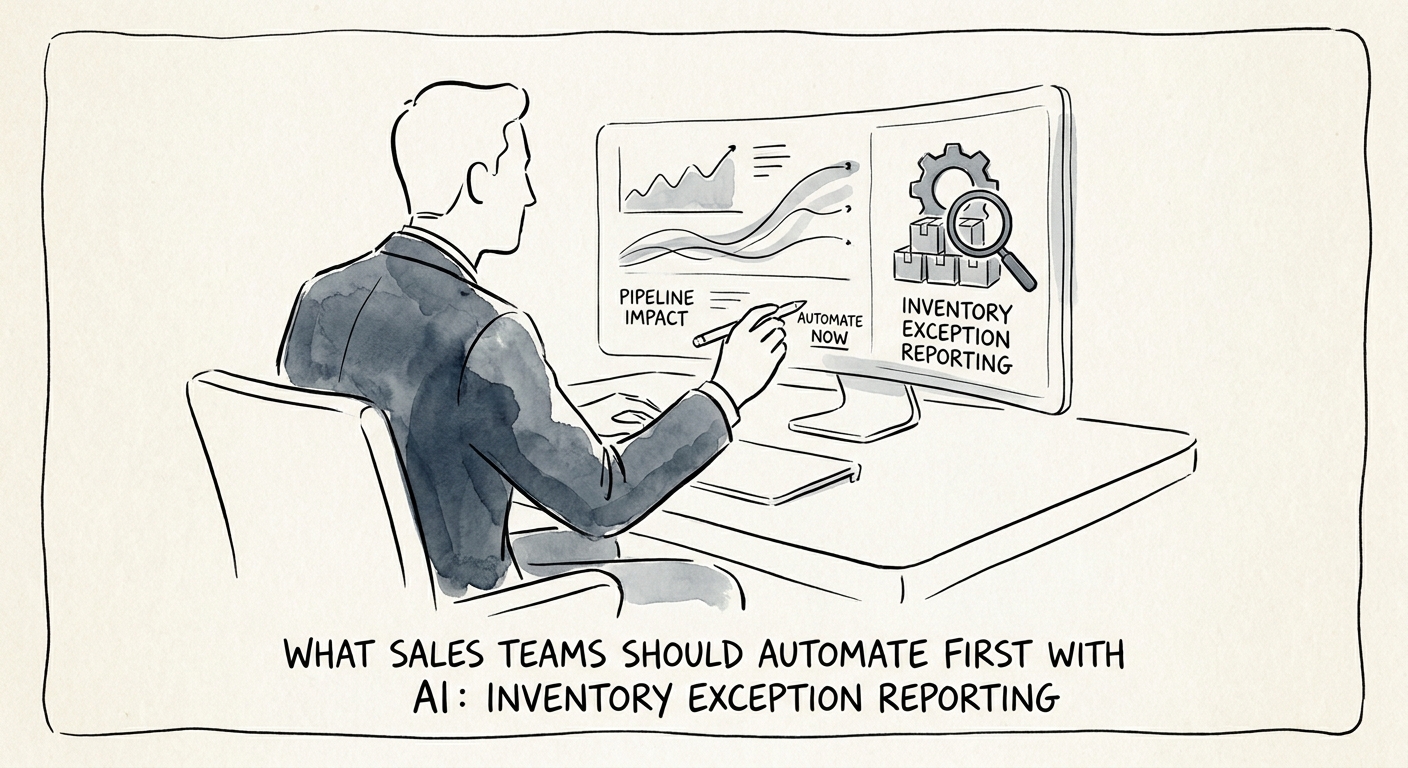
The 4pm Phone Call You Want to Stop Getting
A rep promises a 200-unit reorder for Thursday. Nobody told her the line went on allocation Tuesday afternoon, or that 140 of those units were already committed to a backorder from another region. She finds out at 4pm Thursday — from the customer, who is now on the phone, angry, and rethinking the renewal. The information existed the whole time. It was sitting in the ERP, in the allocation table, in the open-order log. It just never reached the one person who'd made a commitment against it.
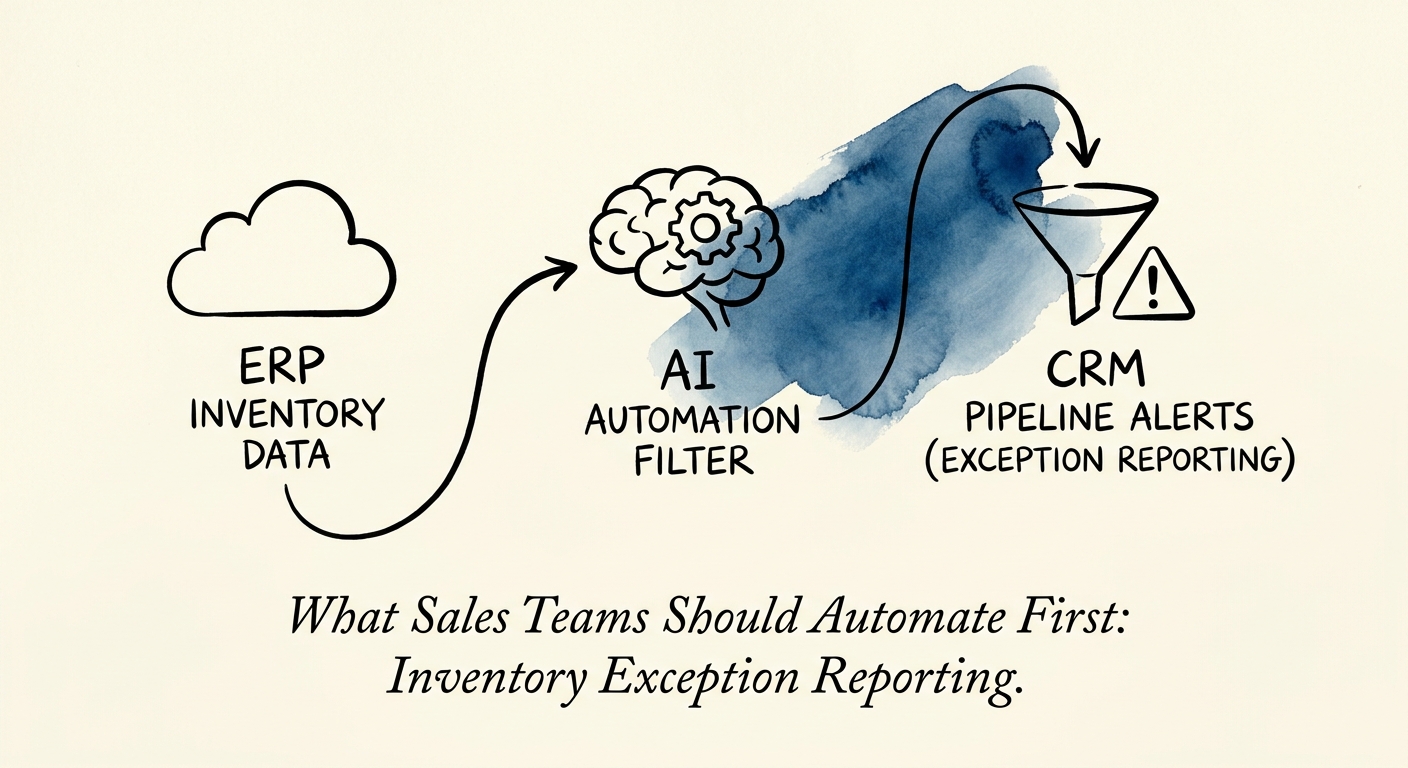
For a distributor or a services firm carrying parts and SKUs, this is the single highest-leverage thing to point AI at first — not because it's flashy, but because the gap is purely a notification gap, not a judgment gap. The system already knows the answer. What's missing is something that watches available-to-promise, allocation rules, substitution options, and backorder thresholds, and tells the account owner the moment one of them moves against a live commitment.
The adoption research is worth reading less for the headline percentages and more for one consistent finding: mid-market and small-business AI value shows up where a specific record, a specific owner, and a specific cadence are wired together — not where a model is asked to be generally smart. The RSM middle-market AI survey, the San Francisco Fed small-business AI analysis, and the OECD SME AI adoption report all point the same direction: the win is operational plumbing, not raw model intelligence. So before you write a single prompt, map four things — which inventory record is the source of truth, who owns the decision when it changes, what output the model is allowed to produce, and where an exception escalates. The model drafts and ranks. The plumbing decides what's trusted.
The Trap: A Confident Answer That Outran the Allocation Table
Here's the failure mode that kills these projects. A rep asks the assistant "can I promise 200 of SKU-4471 by Thursday?" and gets back a smooth, well-written "Yes, you have 340 in stock." It's wrong — because "in stock" and "available to promise" are different numbers, and the assistant read the first one. The 340 included 140 already allocated to a backorder and 60 quarantined for QA. The fluent answer is more dangerous than no answer, because the rep believed it.
That's why inventory exceptions cannot be a free-text question. The four record types have to agree before anyone speaks to a customer: ERP on-hand, allocation policy, open-order commitments, and substitution rules. If the model summarizes ERP without reconciling against the other three, it will confidently sell inventory that's already spoken for. The NIST AI Risk Management Framework is the right scaffolding here — use it to pin down the decision context, the accountable reviewer, and a measurable definition of "wrong" (a promise made against unavailable stock is a tracked failure, not an oops). Use CISA's AI Data Security Best Practices to decide what the model is even allowed to touch: which fields — availability, allocation status, backorder threshold, impacted-account list, customer commitment date — get exposed, logged, retained, or kept out of the prompt entirely.
Practically, every exception the AI surfaces should ship as a small structured packet, not a paragraph: the inventory source it read, the exception type (allocation hold, backorder breach, substitution required), the allocation owner, whether a substitute is approved, the list of impacted accounts, and a logged record if a promise actually changes. Draw the line cleanly. A broad assistant can explain an exception in draft form for a human to act on — fine, keep it advisory. But the moment you want it to re-route allocation, push a substitute, or update a commitment date, you wrap deterministic checks around it. The reconciliation runs in code; the model only narrates what the code found.
One Product Line, Six Numbers, 24 Hours
Run this as a tight pilot on a single product or service line — not the whole catalog. Deloitte's State of AI in the Enterprise 2026 is blunt about the trap most teams fall into: endless pilots that demo well and change nothing. Production value here has one definition — the account owner finds out about a material exception before the customer does. The target worth holding yourself to is notifying the owner within 24 hours of the exception appearing, with a source link they can verify in one click.
Track six numbers, and only six: same-day notification rate, source-mismatch count (how often ERP and allocation disagreed), impacted-account coverage, substitute-approval time, number of customer promises that changed, and the rate at which an account owner had to correct what the AI said. That source-mismatch count is the most valuable thing the pilot produces. If ERP and allocation routinely disagree, you haven't found an AI problem — you've found a broken operating source, and no amount of model polish fixes it. Stop and clean the data before adding another surface.
Before you start, confirm this workflow is actually worth the effort using the manual-work scoring guide, then sequence the build — source cleanup, prototype, reviewer training, launch, scale — with the 90-day AI implementation plan. Monday's move is small and concrete: pick the one product line that generates the most "I didn't know it was out" escalations, and instrument it. Require a source link for every impacted account. After two weeks, ask the only question that matters — did sales hear about the material exceptions before the customers did? Expand it when the answer is consistently yes, and not a day before.