
The practical answer
- Short answer
- How consulting firms use Retrieval-Augmented Generation (RAG) to stop the billable margin leak caused by searching through technical product documentation.
- Best fit
- Industry: Consulting and Professional Services. Function: Operations and Delivery
- Operating path
- AI Knowledge Systems → AI Transformation
- Key metric
- 19,732 The annual cost in dollars per information worker due to document-related inefficiencies, directly eating into consulting firm gross margins.
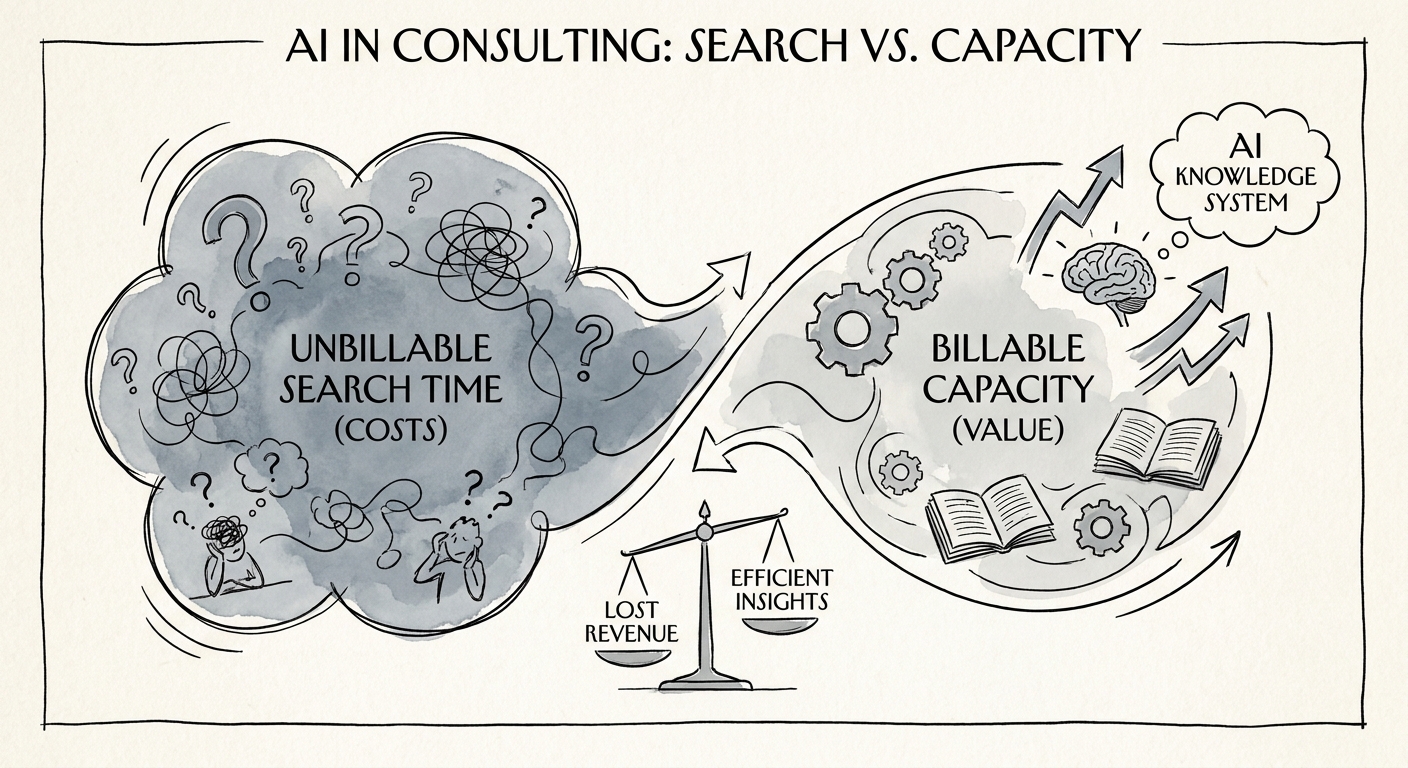
Consulting teams burn nearly a fifth of their billable capacity simply hunting for the correct, current version of vendor product documentation. When I audit professional services firms, the biggest hidden margin leak isn't bench time, scope creep, or client delays—it is the sheer volume of hours senior architects spend searching through fragmented PDFs, disjointed vendor portals, and outdated Slack threads just to figure out how a specific API behaves or what a compatibility matrix actually dictates. This is a massive, unbilled tax on your most expensive talent.
The numbers behind this administrative tax are staggering, and they directly undermine the profitability of your engagements. According to McKinsey's research on knowledge worker productivity, employees spend an average of 9.3 hours per week searching for and gathering information. In a consulting context, where every hour is inventory and utilization rates dictate survival, that kind of friction is an existential threat. When we multiply that time waste by fully burdened engineering rates, we quickly hit a financial wall. IDC's cost of document inefficiencies data estimates this chaos costs businesses $19,732 per information worker annually. For a 100-person software implementation shop, that translates to nearly $2 million in gross margin evaporating into thin air every single year.
In our last engagement with a mid-market systems integrator, I watched a team of senior developers spend three full days manually verifying Workday integration specs across four conflicting versions of product documentation. They weren't building architecture; they were acting as high-priced librarians cross-referencing obsolete wikis. This is exactly why building an AI Knowledge System powered by Retrieval-Augmented Generation (RAG) is the absolute first automation lever an operations leader must pull. But deploying RAG requires strict discipline around source quality, permissions, and data ownership, not just signing up for a new software subscription and hoping for the best.
RAG is not a magic wand for bad data governance. You cannot dump all client-specific architectural decisions into a single vector database without role-based access controls.
Why RAG Beats the Standard Search Bar
If you just point a generic AI model at a shared corporate drive full of client specs, old project notes, and outdated product manuals, you are going to generate very fast, very confident hallucinations. To stop the margin bleed, consulting firms must implement Retrieval-Augmented Generation. This RAG architecture forces the AI to answer questions exclusively using your curated, verified repository of documentation. It explicitly cites its sources in the output, allowing your consultants to verify the answer instantly instead of trusting a black box.
The reality is that product documentation is inherently messy and constantly decaying. Forrester's analysis of agile knowledge management reveals that traditional knowledge sharing practices consistently fail because they rely on static, waterfall-style documentation repositories that nobody wants to maintain. We know from broader industry surveys that nearly half of business decision-makers admit their post-sales technical documentation is weaker and less accurate than their marketing content. When your foundation is this weak, your retrieval testing must be absolutely flawless. You cannot afford an AI that guesses API limits or hallucinates security protocols during a critical client deployment.
Before you invest a single dollar in AI licensing, you must ruthlessly address your data cleanup. Your RAG system is only as good as the documents it ingests. If your firm currently maintains five different, conflicting versions of a Salesforce CPQ implementation guide, the AI will inevitably pull from the wrong one. We always recommend building a dedicated internal knowledge search workflow that actively prioritizes current vendor documentation while aggressively quarantining legacy project files. Your engineers need answers based on today's software version, not what was true three years ago.
Furthermore, technical rework destroys deal profitability faster than any other operational failure. IDC's estimates on rework costs show that 5-12% of total technical project value is often wasted on rework stemming directly from communication breakdowns and documentation gaps. When a consultant uses a properly governed AI Knowledge System that instantly retrieves the correct deployment steps, that rework cost drops to near zero, protecting your project margins.
Governance, Permissions, and Ownership
It is critical to understand that RAG is not a magic wand for bad data governance. I have rebuilt this exact knowledge management function three times for different mid-market consultancies, and the failure point is always the same: permissions and access control. You absolutely cannot dump all of your client-specific architectural decisions and vendor product documentation into a single, flat vector database without rigid role-based access controls in place. If an internal AI assistant accidentally serves one client's proprietary configuration data to a consultant working on a direct competitor's account, you have breached your MSA and potentially triggered a catastrophic liability.
This foundational data readiness gap is actively killing AI initiatives across the technology services industry. In fact, Gartner's widely cited forecast on generative AI adoption predicts that at least 30% of enterprise AI projects will be abandoned after proof of concept, in large part because they lack clean, AI-ready data. To be part of the successful minority, operations leaders must enforce strict data ownership protocols. Every single piece of product documentation ingested into the knowledge system needs an assigned human owner who is directly responsible for version control, periodic auditing, and deprecating outdated material before it poisons the vector database.
If you are planning to deploy these powerful retrieval tools, start by treating your implementation playbooks and product documentation as top-tier corporate assets, not just administrative afterthoughts. You must run rigorous retrieval testing against your most complex, high-stakes consulting scenarios before rolling the tool out to the floor. Ask the AI to resolve a contradictory deployment step or find an obscure integration dependency. If it cannot reliably point your consultant to the exact paragraph in the correct vendor manual, the system simply isn't ready for production. It is time to stop paying your brightest engineers to play hide-and-seek with unstructured PDFs, and start building the governed knowledge infrastructure that actually scales your delivery.