The $412,000 hire that runs your sales cycle longer, not shorter
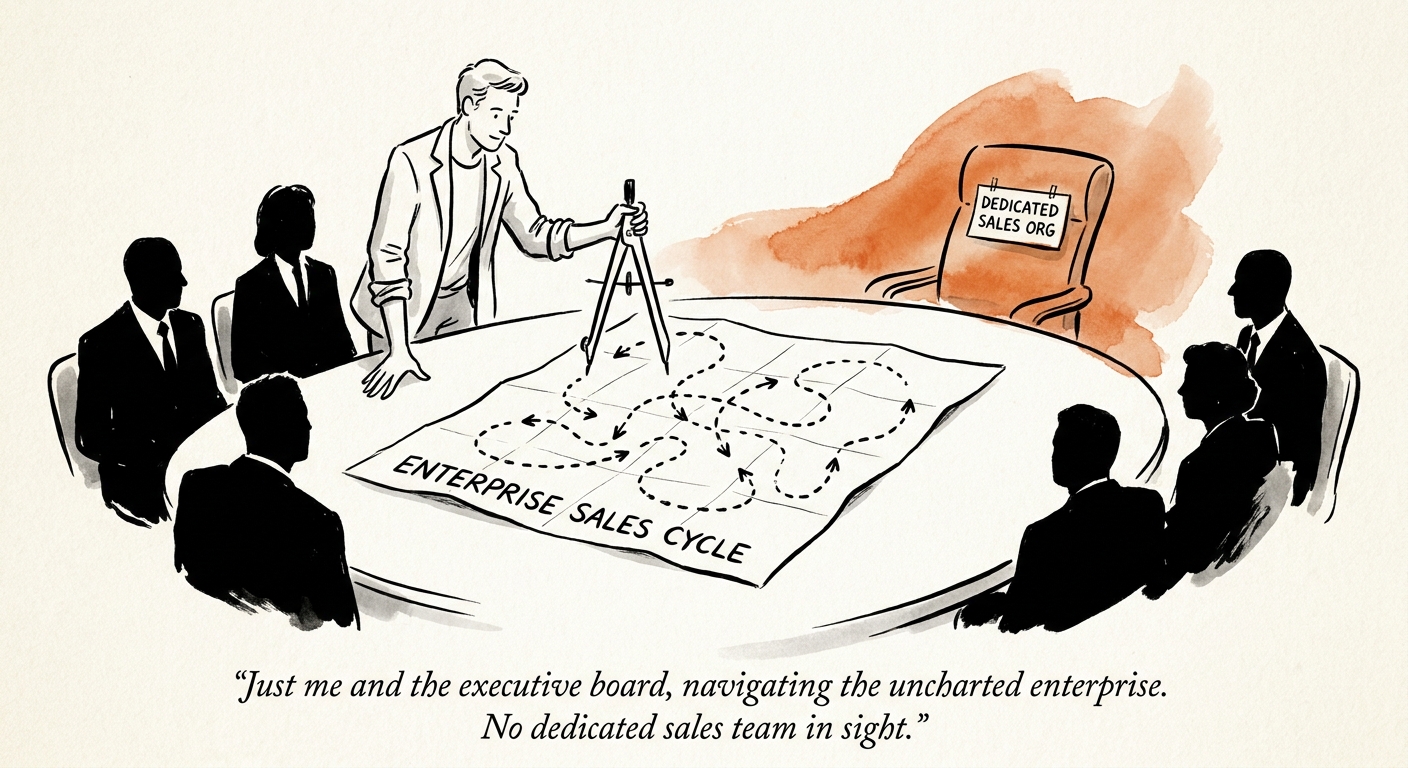
Here is the sequence I keep watching. A bootstrapped SaaS company crosses $3M ARR, lands two enterprise logos almost by accident, and the founder decides the "real" way to scale is to hire a seasoned enterprise Account Executive and get out of the deals. Eighteen months later the AE has burned a full OTE package, the pipeline they built is mostly stage-one ghosts, and the sales cycle has somehow gotten longer. The premature enterprise hire before $5M ARR routinely adds months to the cycle and torches several hundred thousand dollars in OTE you will never recoup. When you have no outside funding, that is not a learning experience. That is a quarter of your runway, gone.
The reason it fails is not that the AE is bad. It is that a Fortune 500 sponsor buying from a 40-person, unfunded company is making a career bet, and a mid-level relationship manager cannot underwrite a career bet. The corporate champion who pushes your unproven tool through procurement is personally exposed if you ship late, get acquired, or run out of cash. What they want, before they sign, is a direct line to the person who decides what gets built and whether the company survives. That is you. Bain & Company's 2024 B2B Founder-Led Sales Analysis found founders acting as the primary enterprise closer post a 42% higher win rate than the first three external sales hires a company brings on. The bootstrapped version of that number is even starker, because you cannot afford to burn through three failed hires to learn it.
So stop treating "no sales org" as the gap you need to fill with a check you can't write. It is leverage. You can rewrite a contract clause on a Tuesday call. You can promise an integration and have it in staging by Friday. An incumbent with a 200-person sales floor cannot do either without six weeks of internal approvals. If your problem is converting that agility into language a VP of Engineering will sign off on, read Why Technical Founders Lose Enterprise Deals: The Translation Problem next, because the founder edge evaporates the moment you describe your product as a feature list instead of a business outcome.
You can't clone yourself. Build the pod that does it for you.
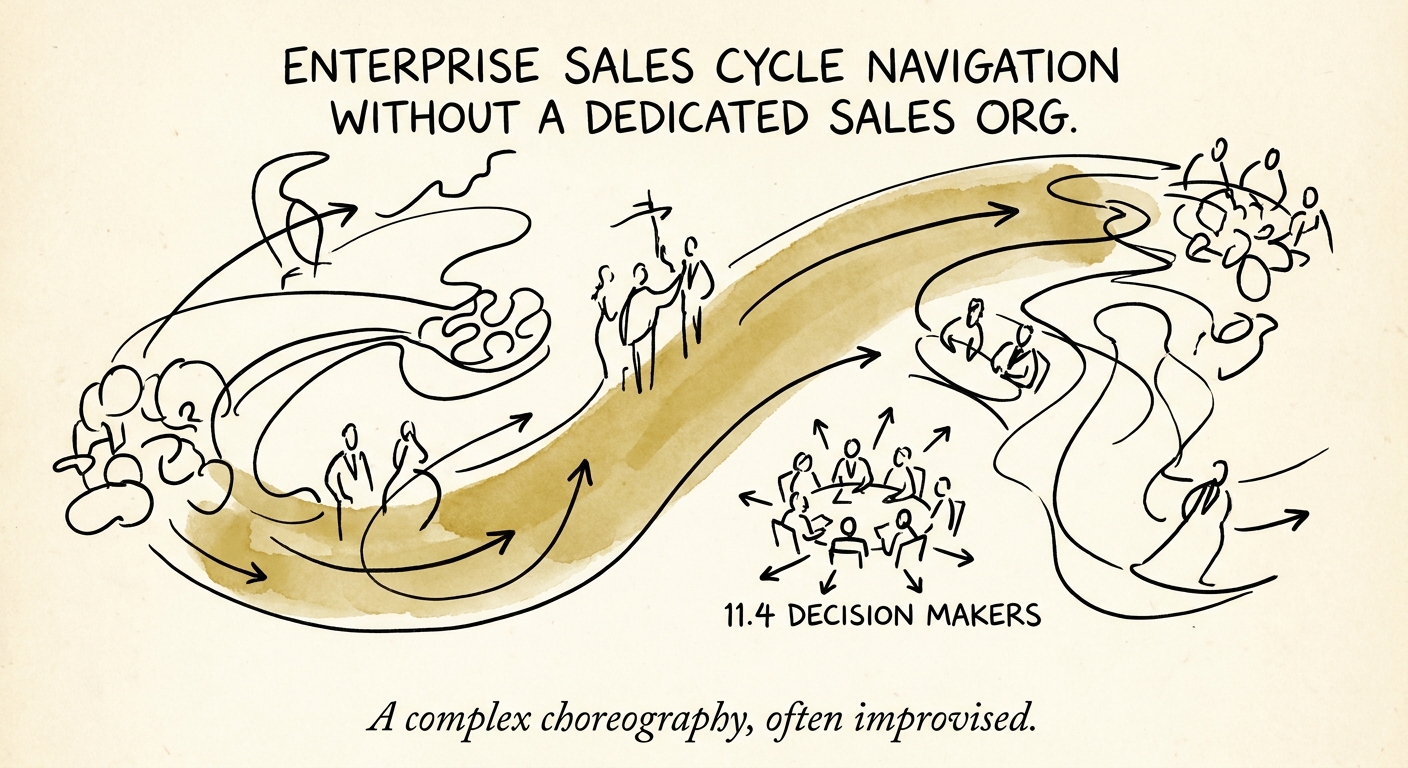
The trap on the other side is thinking founder-led means founder-alone. It doesn't, and it can't, because the modern enterprise deal is not one conversation. Gartner's 2024 B2B Complex Buying Journey Report puts the average enterprise buying group at 11.4 independent decision-makers. Eleven people, each with a private agenda, each able to quietly kill the deal by simply not responding. A lone founder cannot service eleven stakeholders and still ship product. But a bootstrapped company has assets a 12-person AE pod does not: the people who actually built the thing.
Map your existing team onto the buying group instead of hiring against it. Your Head of Product runs the demos and discovery as a sales engineer would. Your lead engineer takes the security architect and the integration evaluators, because the buyer's technical reviewers will trust the person who wrote the code over anyone with "sales" in their title. Your customer success lead becomes the implementation voice, answering the "what does onboarding actually look like" question that procurement always asks and incumbents always fudge. None of these people need new headcount. They need 20% of their week pointed at deals, and a founder who shows up as the executive peer.
Run two threads, not one
The fastest way to lose a bootstrapped enterprise deal is to be single-threaded: one champion, one relationship, one career change away from zero. So thread it. When your champion offers an intro to their VP or economic buyer, you use your founder title to match seniority and talk enterprise risk, total cost, and what your company looks like in three years. Simultaneously, your technical leads are deep in API docs and rollout timelines with the evaluators. PwC's B2B Enterprise Effectiveness Study found executive-to-executive multi-threading cuts late-stage procurement delays by 28% — which for an unfunded company is the difference between a deal closing inside your cash horizon or after it.
This also forces a commercial reflex into your product and engineering org that you cannot buy. Engineers who sit across from a hostile security reviewer start building with the next deal's questionnaire in mind. That said, founder-pod heroics have a ceiling, and you need to see it coming before it caps your growth. Pull up 7 Signs Your Founder-Led Sales Process Won't Scale Past $10M so you know the exact moment the leverage flips and it's time to layer in real revenue operations.
Make the pilot pay you, and make procurement work before you need it
The phase that quietly kills bootstrapped enterprise deals is the technical validation period. McKinsey's B2B Enterprise Growth Equation shows deals above $250k ACV carry an 8.4-month incubation period by default. Hand that buyer a free, open-ended pilot and you guarantee it stretches past twelve months — and a company with no runway buffer cannot finance a year-long science project on a maybe.
So I run a different playbook with founders: no free pilots, ever. Structure the proof of concept as a paid, time-boxed engagement with a written exit test. The dollar figure matters less than what it triggers. When a buyer pays for the evaluation, they assign a project manager, allocate internal resources, and put their own credibility on the line — which is exactly the commitment that converts. Harvard Business Review's Enterprise Sales Cycle Benchmarks put paid pilots with rigorous exit criteria at an 81% conversion to multi-year contracts, versus 34% for free trials. Attach a one-page Mutually Agreed Action Plan to every PoC: if success criteria X, Y, and Z are hit by day 45, the customer signs the master agreement and moves to full rollout by day 60. Put the dates in writing. The buyer will respect the rigor; it signals you've done this before.
Front-load the gauntlet your champion forgot to mention
The last way bootstrapped teams get crushed is celebrating a champion's verbal "yes" and then walking into a 90-day vendor onboarding, security review, and legal cycle they never planned for. That dead space at the end of the deal is where your runway dies. The fix is unglamorous and almost never done: the moment a champion signals intent, request the vendor intake forms, the MSA template, and the security questionnaire — and start filling them out during the paid pilot, not after the handshake. You will collapse weeks off the back end of the deal. (For the full anatomy of how unmanaged pilots wreck velocity, see The POC Trap: When Free Pilots Destroy Sales Velocity.) Closing enterprise contracts with no sales org and no funding is not a handicap you apologize for. It is proof you can run a disciplined process on conviction and cash discipline alone — which is the exact muscle that lets you raise prices, hire deliberately, and keep the equity.