The CoE that lives on a slide and the one that lives in a data room
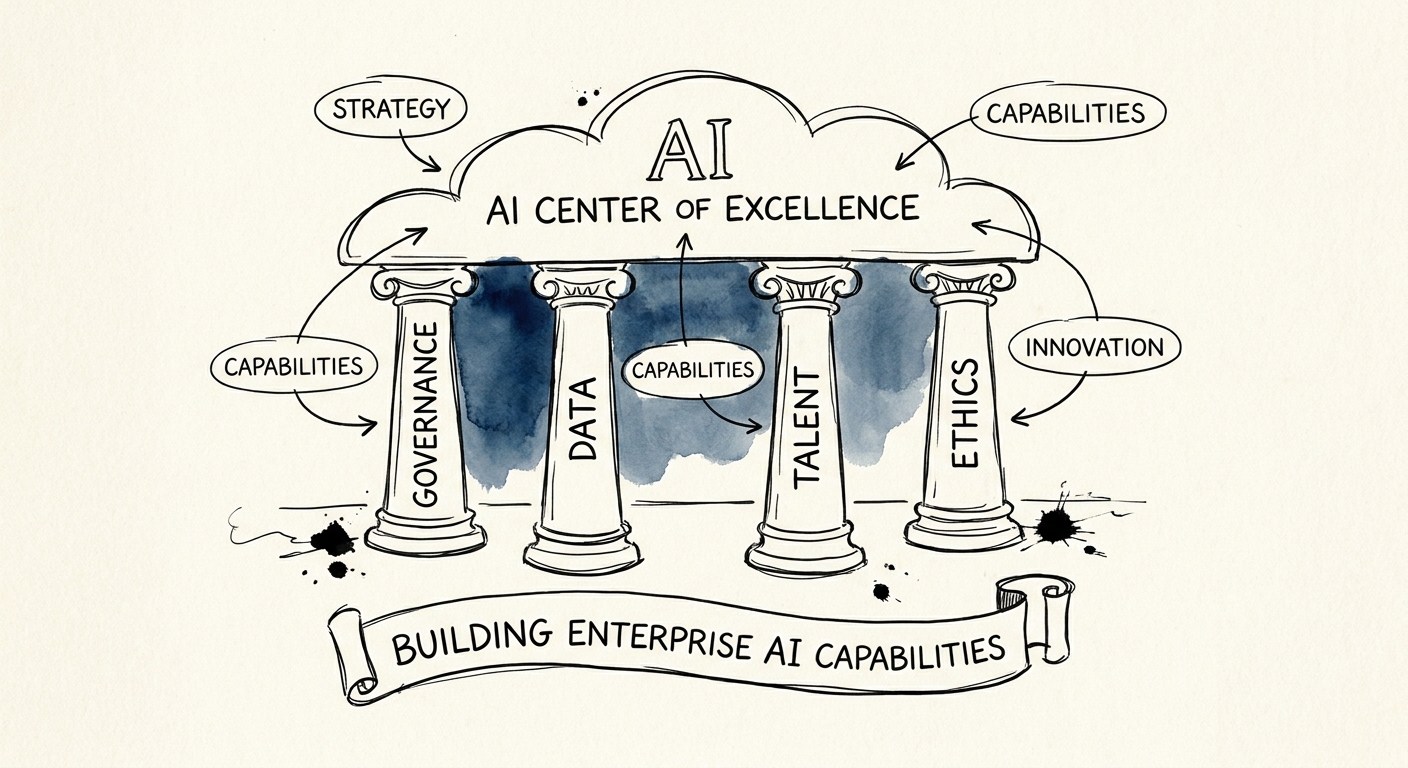
I have walked into the same conference room three times in the past year. A SaaS company, somewhere between 200 and 400 people, shows me an org chart with a box labeled "AI Center of Excellence." Inside the box are names. A VP, two staff ML engineers, a data scientist on loan from the analytics team. Everyone is proud of the box. Then I ask one question: "Show me where you write down which data each model was trained on." The room goes quiet, because the answer is a Slack thread and one person's memory.
That is the entire difference between a Center of Excellence and a headcount line item. A CoE is not the people. It is the paperwork the people are required to produce before a model is allowed near a customer. When I rebuilt this for a $45M B2B SaaS platform last year, we did not write a single line of model code. We wrote standard operating procedures, and the first one was a one-page data-source manifest that every feature had to fill out before its first training run. Six generative features were already shipping. Not one of them had a manifest. Each engineering pod had quietly built its own data-cleaning script and its own definition of "good enough," which meant the company was running six AI products and could prove the safety of zero of them.
This is why pilots rot. Gartner's 2024 AI Scaling and Governance Benchmark found that organizations without centralized, documented governance watch 70% of their models die in the gap between prototype and production. The models don't fail because the math is wrong. They fail because nobody can answer the boring questions — where did this data come from, who approved it, what happens when it drifts — and a model nobody can vouch for never gets the green light to scale. McKinsey's 2024 State of AI Report puts a number on the other side of that ledger: companies with a real, documented cross-functional CoE pull 2.5x more financial value out of the same AI spend. Same engineers. Same compute. The delta is the filing cabinet.
The four documents that actually constitute a CoE
Strip away the consulting language and a Center of Excellence is four living documents, each owned by a named person, each updated before deployment rather than after an incident. If your AI lead cannot pull these up on a screen in under five minutes, you have a shadow IT group accumulating technical debt under a flattering name. The fastest way to find out where you stand is to make them prioritize technical debt remediation against this exact list.
1. The data-source manifest. One row per dataset feeding any model: where it came from, the license or contract that grants the right to use it, the date of the last refresh, and who signed off. When a buyer audits AI, their first question is never accuracy — it's provenance. Can you prove you have the legal right to train on the data underneath your product? MIT Sloan's research on AI Centers of Excellence found that strictly documented ingestion cuts deployment time by 45%, for the unglamorous reason that engineers stop rebuilding the compliance check from scratch on every feature.
2. The model registry. Every model in production gets a card: version, the data-source manifest it points back to, the evaluation thresholds it had to clear, and the human who approved the release.
3. The evaluation standard. This is the document most B2B SaaS teams skip, and it's the one that lets a CEO compare features at all. It names the exact metrics — precision, recall, latency, token cost per call — and the floor each must hit. Without it, every pod grades its own homework on a different curve. PwC's 2024 AI Business Survey found 68% of executives admit their governance lacks the documented procedures needed to measure model ROI at all.
4. The go/no-go deployment checklist. The signed gate that says this model cleared the standard, the data is licensed, and a named human owns the rollback. A registry that points to a non-existent manifest, or an eval standard nobody enforces at the gate, is exactly the kind of technology due diligence red flag that turns a clean diligence into a price renegotiation.
What the paperwork is worth when someone buys you
Here is the part founders underweight. These four documents are not overhead — in a sale, they are the difference between AI that adds to your multiple and AI that gets struck from the model entirely. A buyer in today's market is not excited by your generative features. They are scared of them: hallucination liability, copyright exposure on training data, and a cloud bill nobody is watching. A documented CoE works as their insurance policy. It proves your AI is systems-dependent, not hero-dependent — that it runs the same way whether or not your sharpest engineer is still around after the earnout.
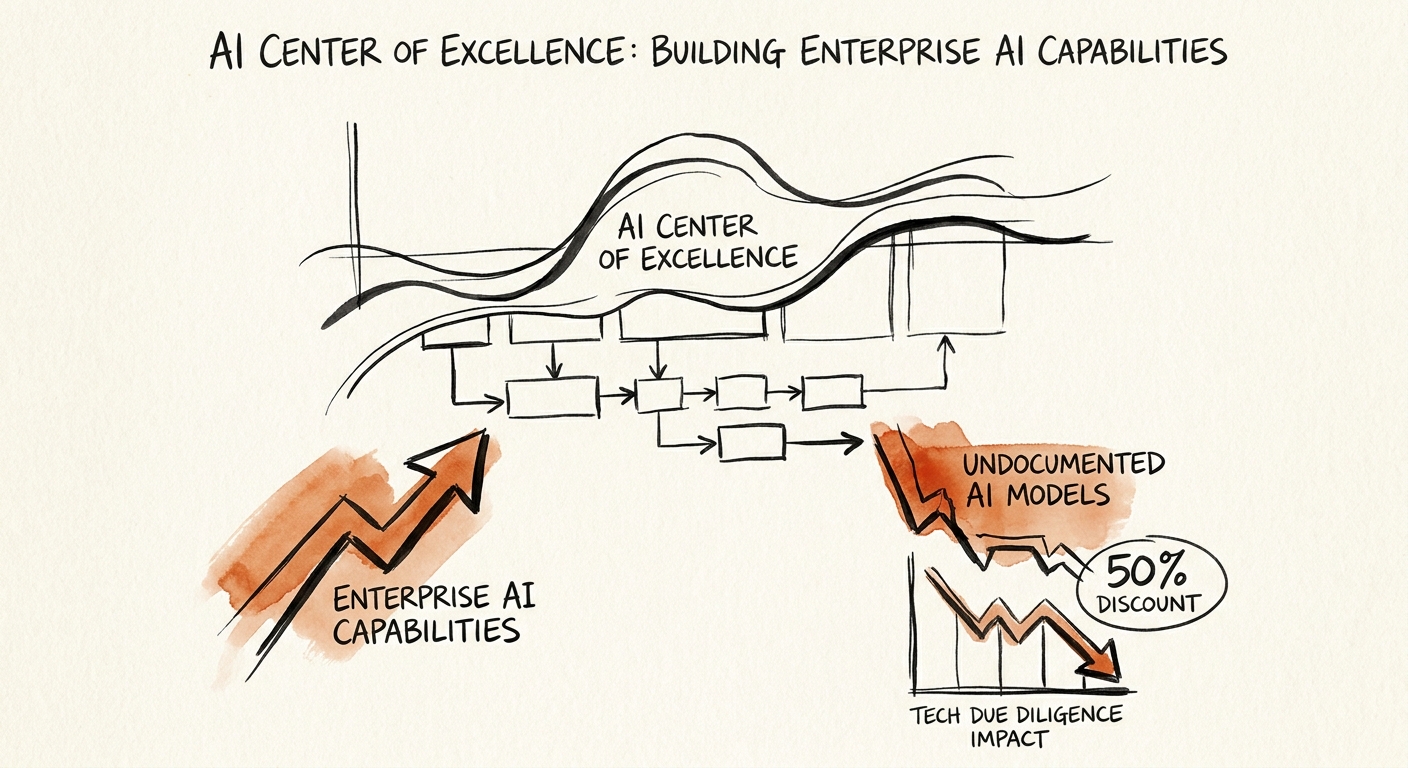
The discount for skipping this is brutal and specific. EY's 2025 AI Scaling and Investment Study found that AI initiatives without formal process documentation and clear data lineage take up to a 50% valuation discount in technical diligence. In practice it's worse than a discount: when a buyer can't verify how a model was built, they don't haircut the AI revenue, they delete it from the quality of earnings entirely. Your proprietary models stop being an asset and become an unpriced risk. That is why your data-source manifest doubles as the spine of your intellectual property documentation — the same paperwork that protects you on Tuesday is what your buyer's lawyers demand on closing day.
If you want one move this week: take your single most prominent AI feature and try to fill out the data-source manifest for it — every dataset, every license, every approver, on one page. The features where you can't finish the page are the ones quietly carrying your largest liability, and now you know where to start. Build the four documents before you scale the eighth feature. Skip them, and you haven't built a Center of Excellence. You've built a very expensive science fair that goes quiet the moment a buyer looks under the hood.