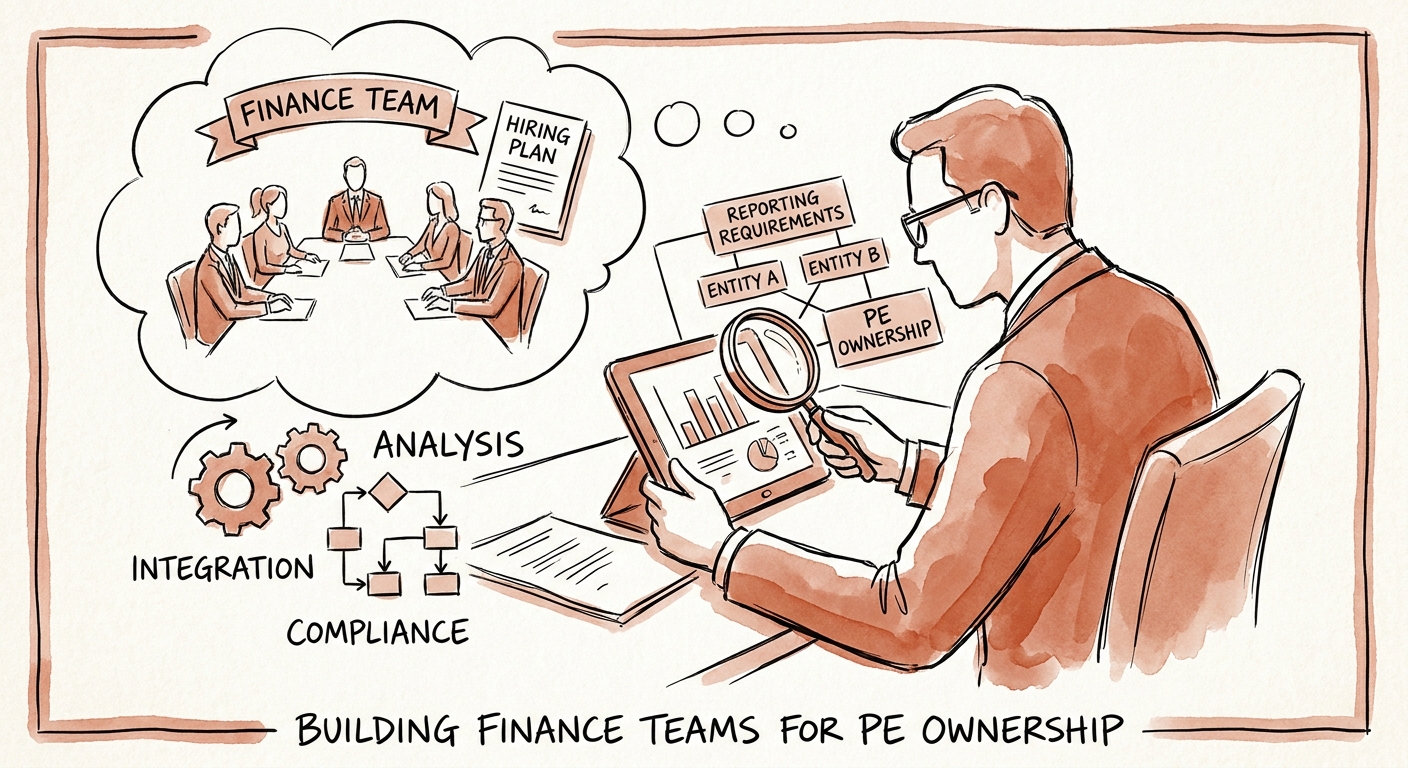
The first board meeting is a reporting test in disguise
Day 38 after a close. A founder-built finance team is presenting to the new sponsor for the first time. The CEO walks through the strategy deck, everyone nods, and then an operating partner asks one question: "Can you show me cash next Tuesday versus the 13-week forecast?" There is no 13-week forecast. There is a month-end spreadsheet that was last touched eleven days ago and a controller who reconciles bank statements by hand. The room goes quiet. That silence is the moment the value-creation plan slips a quarter — not because the business is broken, but because the finance function can't keep pace with how fast the new owners need to see the numbers.
This is the violent shift founders rarely brace for. A founder-led board tolerates a lagging 25-day close and a static, unlinked workbook because the founder already knows the business in their gut. Institutional ownership replaces gut with cadence. The sponsor doesn't want a story; they want daily cash and a rolling forecast, and they want it inside the first 60 days. Bain & Company's Global Private Equity Report 2025 documents that the majority of middle-market buyout funds now expect daily cash visibility and a weekly 13-week rolling cash flow forecast almost immediately post-close. If the team you inherited can't produce that, the gap isn't a nuisance — it's the first thing the board learns to distrust.
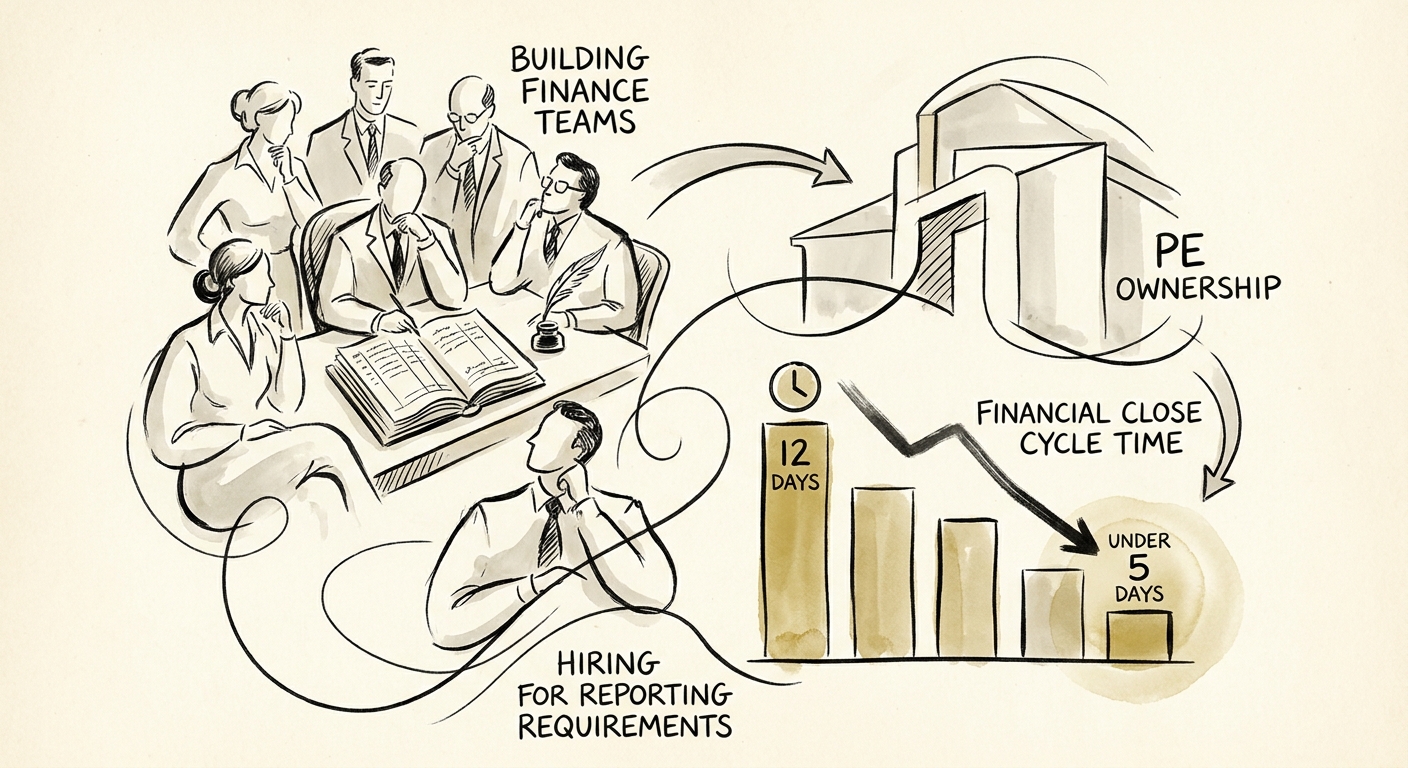
The latency itself is what does the damage. Gartner's 2025 Financial Close Cycle Time Benchmarks put top-quartile finance functions at a hard close under 4.5 days while the bottom quartile sits at 12 or more. The difference between those two numbers is the difference between steering the business and reading a postmortem. You cannot run a 100-day plan on books that describe a world that ended six weeks ago. Diagnosing why your close takes too long is the unglamorous prerequisite to everything that follows — and it usually surfaces who on the current team is capable of fixing it and who is not.
You're not hiring accountants anymore — you're hiring a translation layer
Here is the hiring mistake I watch portfolio companies make on repeat: they try to upskill the bookkeeper who has been loyal since the company was twelve people. It feels humane. It costs you a quarter. Deloitte's Private Equity Finance Talent Benchmark finds that most legacy founder-led finance teams lack the FP&A capability to support institutional reporting at all — and FP&A is not a skill you teach someone who is comfortable closing in three weeks. It's a different job with a different brain.
So bifurcate the function on purpose, and do it early. On one side: transactional accounting, AP/AR, compliance, the disciplined hygiene that keeps the general ledger clean. On the other: forward-looking FP&A that turns that ledger into the operating partner's weekly KPIs. The single highest-return hire for a newly acquired company is a technically fluent FP&A director who lives in the gap between raw GL data and the cohort, retention, and unit-economics numbers the board actually tracks. Without that person, your CFO degenerates into a report-compiler instead of a co-pilot to the CEO. Before you commit to a full executive package, run the math on whether you even need one yet — the fractional CFO vs. full-time CFO decision matrix exists precisely so you don't over-buy seniority at the wrong revenue stage.
What you screen for changes too. The old rubric asked whether a candidate could reconcile and accrue. The new rubric asks whether they've stood up multi-entity consolidations natively in NetSuite or Sage Intacct, whether they can write SQL against the data warehouse instead of waiting on an analyst, and whether they can build a defensible three-statement model under a deadline that does not move. That last skill matters more than it sounds: PwC's 2025 M&A Integration Survey notes that organizations with fully automated, cloud-based reporting close bolt-on acquisitions meaningfully faster than those still extracting data by hand — and in a buy-and-build thesis, that speed is the thesis. A finance hire who can't operate the reporting stack is a finance hire who becomes the bottleneck on the next deal.
The 100-day talent sprint, and the audit you run in week one
Timing is the most unforgiving variable in finance-team construction, because the clock is borrowed. Operating partners expect a functioning, predictive reporting engine inside 100 days of the hold. If you discover at that first board meeting that your finance lead can't build a 13-week cash model, you've already burned a quarter — and the replacement search will eat another four months on top of it. That's two-thirds of your first year spent without a finance function the board can rely on, which is why I run the talent audit in week one rather than month four.
The audit is one question, asked of whoever currently runs finance: walk me through the bridge from trailing-twelve-month EBITDA to next quarter's bookings forecast. If they can do it cleanly, you may have your operator. If they reach for the prior year's actuals and start hedging, you have a transition to plan — and you plan it now, while you have runway, not after the diligence team finds the same gap for you. You cannot teach operational velocity to someone who is genuinely comfortable with monthly ambiguity; that comfort is the disqualifier.
The reason all of this is non-negotiable shows up at the far end of the hold, during sell-side diligence. KPMG's 2024 Quality of Earnings Report Analysis shows that targets with poorly structured historical financials take a real haircut to their final multiple, driven by negative EBITDA adjustments and the trust a buyer quietly withdraws the moment the numbers look improvised. Messy financials read to an institutional buyer as operational chaos, whether or not the business is actually chaotic. The finance team you build in the first 100 days is the same team whose work product a buyer scrutinizes on the way out — which is why I treat it as the first line of defense against a diligence haircut, not a back-office cost.
To land this caliber of operator, pay for the cadence, not the title. PE portfolio CFO compensation benchmarks show base has risen, but real alignment comes from front-loaded equity and bonuses tied to the things the sponsor actually rewards: close-cycle compression, reporting accuracy, and margin expansion. The pool of proven PE-backed finance operators is shallow, and the good ones have options — so move decisively, structure the equity to reward speed, and start the week-one audit before you've finished unpacking the data room. Do it in that order and the first board meeting becomes a demonstration instead of an ambush.
