
The practical answer
- Short answer
- Learn why invoice routing is the highest ROI AI automation for customer service teams. We cover the hidden costs, workflow design, and governance rules.
- Best fit
- Industry: Cross-Industry. Function: Customer Service
- Operating path
- AI Function Use Cases → AI Transformation
- Key metric
- 40-50% Reduction in human service interactions via AI-enabled operations.
Your customer service agents are secretly acting as human mail-routers for finance, and it is costing your business an average of $8.01 per ticket, as shown in Gartner's 2026 customer service benchmark, just to forward a PDF attachment. We see this silent margin leak in almost every operational audit we conduct across scaling B2B businesses. Customers and vendors routinely and blindly email your main support addresses with complex billing inquiries, past-due payment notices, and inbound invoices. Instead of solving actual customer problems or preventing churn, your front-line support team is forced to open the email, download the attachment, realize it belongs to the accounting department, and manually create a new internal ticket to reroute it.
The Double Tax of Manual Routing
In our last engagement with a 200-person logistics firm, I found that 18% of their tier-one support queue consisted entirely of misdirected financial documents. I have rebuilt this team three times across different portfolio companies, and the pattern is always the same: highly paid, highly trained agents are reduced to copy-pasting vendor invoices into Slack channels or internal Jira boards. This represents a severe misallocation of human capital. Every minute an agent spends deciphering a vendor's billing inquiry is a minute stolen from saving an at-risk renewal. This creates a compounding financial penalty that destroys your unit economics. First, you pay the $8.01 support ticket resolution cost simply to touch the email. Then, the invoice lands in finance, where you pay a median cost of $10.18 for manual invoice processing, according to APQC's 2024 Accounts Payable Practices Report. You are paying nearly $20 to process a single document because your front-line routing architecture is broken.
Mid-market operators cannot afford this double-tax on their operating margins. Customer service teams should be relentlessly focused on retention, product troubleshooting, and account escalation management. When you force them to act as an intake funnel for Accounts Payable and Accounts Receivable, you artificially inflate your support headcount and drastically degrade your response times for legitimate customer crises. If you are evaluating Best First AI Use Cases for Customer Operations Teams, invoice routing is the absolute highest-ROI starting point because it completely removes a non-value-added workflow from your service board.
Automate the predictable, meticulously protect the exceptions, and stop paying your support agents to do finance's data entry.
The AI Invoice Routing Workflow
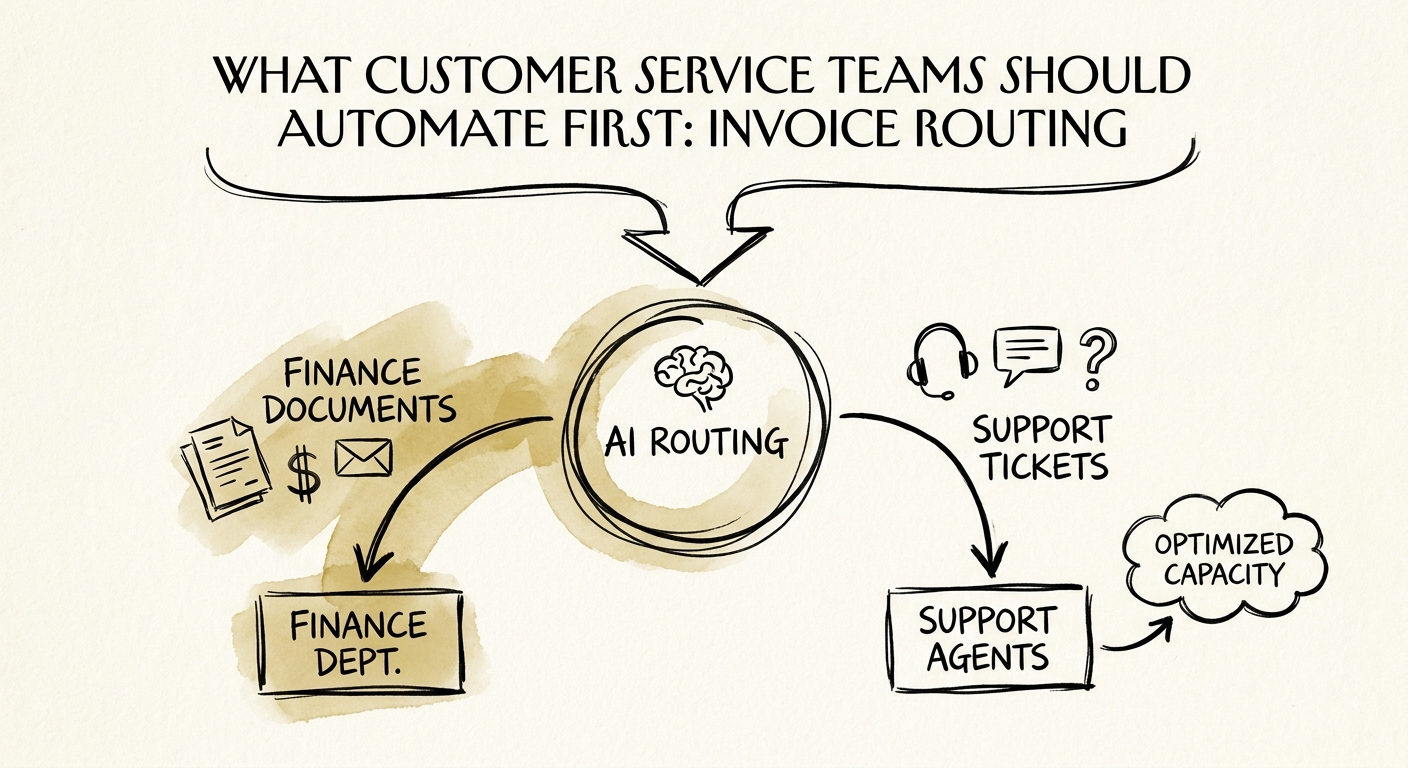
Fixing this administrative burden requires shifting from manual triage to intelligent document processing at the exact point of ingestion. We deploy specialized AI agents directly connected to the customer support inbox to intercept financial documents before a human agent ever sees them. When an email arrives with an attached invoice, the AI evaluates the body text, the sender domain, and the attachment itself. Modern Large Language Models natively read unstructured PDFs, identify the vendor name, extract the purchase order number, recognize the line items, and classify the intent as a strict billing event rather than a support request.
API Pipelines and Handoffs
The underlying architecture requires secure API connections and precise data mapping. We typically configure the AI agent to extract standard fields and cross-reference them with active records in the ERP. Once classified, the AI strips the email out of the customer service queue entirely. It bypasses Zendesk or Jira Service Management and pushes the structured payload directly into the finance system. By implementing this direct-to-finance pipeline, companies can achieve the $2.78 target for best-in-class automated invoice processing documented in Ardent Partners' benchmark research. The AI effectively bridges the gap between the chaotic customer-facing inbox and the highly structured back-office ledger without ever requiring a support agent to act as the manual middleman.
The operational leverage generated here is massive and immediate. We rely on McKinsey's analysis on contact center automation, which proves that AI-enabled service operations can reduce human interactions by 40% to 50%. In practice, this means you instantly reclaim hundreds of agent hours per month. Instead of hiring another tier-one support rep just to keep up with queue volume, you redirect your existing team toward high-complexity, revenue-protecting work. We also structure the workflow to automatically reply to the sender, acknowledging receipt and providing the correct direct finance contact. This systematically retrains the customer's behavior for the next billing cycle. If you want to dive deeper into the exact financial math and payback periods, review our comprehensive guide on How to Measure AI ROI for Invoice Routing.
Governance and Implementation Risks
You cannot deploy an AI routing system without strict, exception-based governance. If the AI aggressively closes tickets and misroutes a critical vendor invoice or an angry customer's billing dispute, the operational fallout is severe. I always implement a rigid confidence threshold for these deployments. If the AI is less than 95% certain that an attachment is a standard, run-of-the-mill invoice, it must leave the ticket in a designated triage queue for human review. If you let the AI hallucinate vendor names or automatically delete emails it mistakenly classifies as spam, you will break your supply chain, delay payments, and infuriate your customers.
Protecting the Customer Experience
The true cost of a bad automation deployment is permanent customer churn. We know that 63% of customers will abandon a brand after just one bad AI interaction, as confirmed by Zendesk's CX Trends Report. To prevent this catastrophic outcome, we design the AI to be entirely invisible to the customer during the routing phase. The AI is not a conversational chatbot trying to argue about a bill; it is a silent, asynchronous background router. If the email contains words indicating frustration, contract disputes, or legal threats, the AI is explicitly instructed to flag it as an urgent escalation for a human financial operations manager, bypassing the standard invoice ingestion flow completely.
This is precisely why we treat AI transformation as a structural operations project, not a weekend IT experiment. You must meticulously map the API connections between your support helpdesk and your ERP, define the fallback rules for encrypted or unreadable PDFs, and establish a clear RACI matrix for when the integrations inevitably break. Finally, the system must maintain an unalterable audit trail. Every action the AI takes, from the initial interception of the email to the final API payload sent to the ERP, must be logged for compliance and security reviews. Finance teams need absolute visibility into how an invoice entered their system. For operations teams looking to expand this logic beyond billing and invoicing, applying similar governance frameworks to AI Ticket Triage for Support Teams ensures that your entire front-line operation becomes an intelligent, self-sorting engine. Automate the predictable, meticulously protect the exceptions, and stop paying your support agents to do finance's data entry.