
The practical answer
- Short answer
- Why manual dispatch exception handling costs $1,000 per truck roll, and how AI agentic workflows recover capacity and protect field service margins.
- Best fit
- Industry: Field Service & Logistics. Function: Customer Service & Operations
- Operating path
- AI Function Use Cases → AI Transformation
- Key metric
- $1,000 Average margin bleed per failed truck roll
Dispatch exceptions are not a 5% operational edge case; they are a margin-destroying tax that consumes up to 41% of your dispatchers' manual capacity and bleeds over $1,000 per wasted truck roll. I see operations leaders constantly misclassify cancellations, bad addresses, and missing parts as "unavoidable friction." They treat exceptions as anomalies. But when you look at the raw data in any field service or logistics organization, the exception is the rule. The cascade effect of a single missed appointment contaminates the entire daily schedule, forcing human dispatchers to abandon strategic planning to play a high-stakes game of calendar Tetris.
Every time a technician arrives at a site without the right parts, or a customer cancels while the truck is in transit, your unit economics collapse. According to the Technology Services Industry Association's field service benchmarks, a single truck roll costs the average business upwards of $1,000. When that truck roll fails, the financial damage multiplies exponentially. Data from Aquant's 2022 Service Intelligence Benchmark Report reveals that an average failed first visit leads to 2.5 additional follow-up visits and adds 20 days to the mean time to repair (MTTR). You cannot scale a service organization if your profit margins are entirely dependent on perfect, uninterrupted daily execution.
The root cause of this margin bleed isn't the exception itself—it is the manual triage required to fix it. When a customer calls to reschedule an appointment that was supposed to happen in twenty minutes, a human dispatcher has to pause their workflow, call the technician, update the CRM, find a new slot for the customer, and desperately attempt to reroute the technician to a new job to prevent dead time. This manual coordination overhead prevents teams from scaling without adding headcount linearly. If you want to stop the bleeding, you need to understand AI ticket triage for support teams, and specifically, why dispatch exception handling must be your very first automation target.
You cannot build a durable enterprise value when your service delivery relies on human heroics to patch a leaky scheduling system.
The Automation Multiplier: Stopping the Schedule Cascade
In our last engagement with a regional commercial HVAC business, we found their dispatchers were spending 70% of their working hours reacting to cancellations and frantically rerouting technicians via WhatsApp and phone calls. The institutional knowledge of which technicians possessed which certifications, and which routes made geographical sense, lived entirely inside the head of their lead dispatcher. When she took PTO, the daily revenue velocity dropped by 20%. This is the definition of operational fragility. You cannot build a durable enterprise value when your service delivery relies on human heroics to patch a leaky scheduling system.
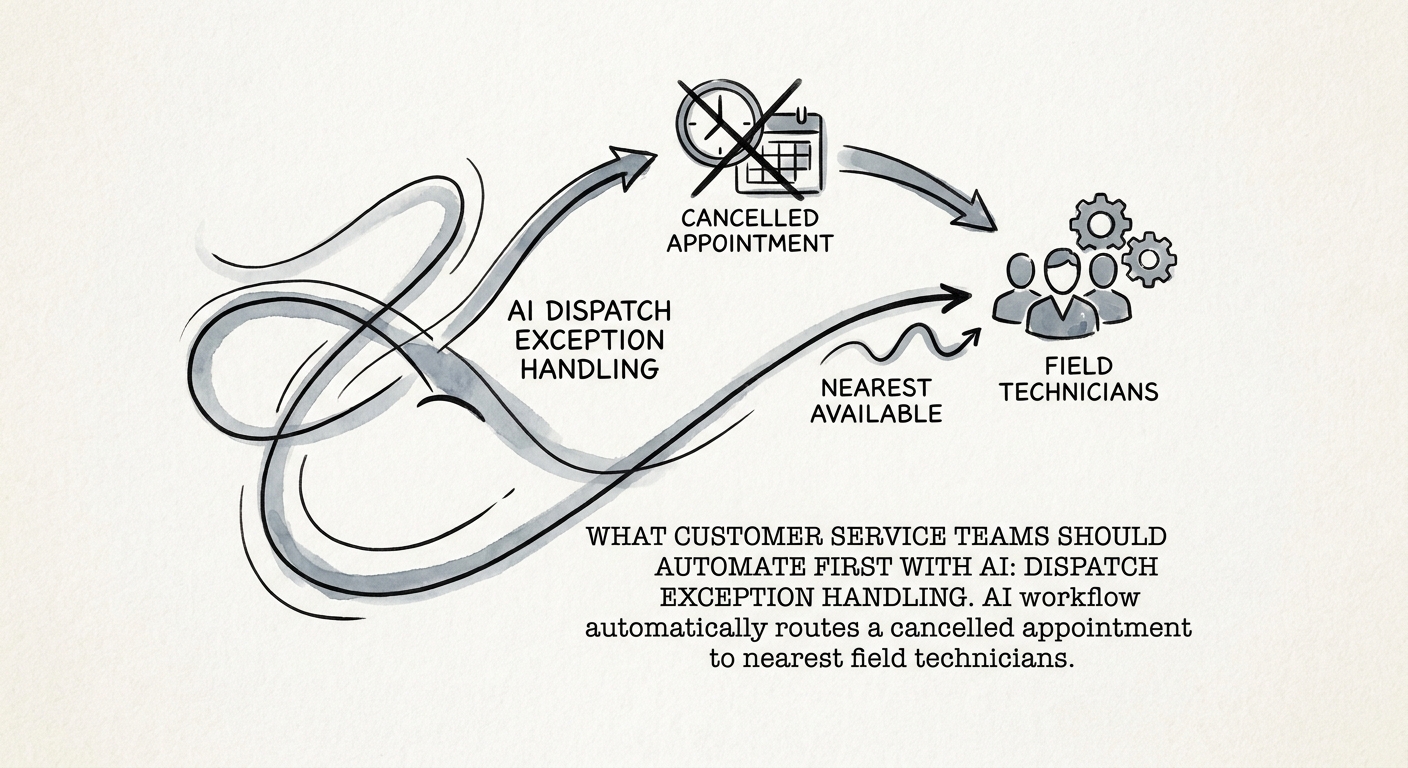
Automating dispatch exceptions flips the script. Instead of relying on a human to manually cross-reference technician skills, geographic proximity, and available inventory, an AI agentic workflow ingests the cancellation signal and instantly recalculates the optimal next step. The technology has evolved far beyond rudimentary rule-based bots. According to Salesforce's field service scheduling optimization guidance, AI agents can reduce manual dispatcher workload by as much as 41% and free human operators to focus on high-value client relationship management.
The impact on the bottom line is immediate. When an exception occurs, the AI system can simultaneously text the customer with rebooking options, cancel the original dispatch, alert the technician to divert to the next closest high-priority job, and update the ERP—all in milliseconds. This eliminates the "dead drive time" that kills service margins. In practice, resolving a shipping or service exception manually can consume anywhere from a half hour to well over an hour of dedicated coordination time per incident. Automating this workflow recovers hundreds of hours of lost labor capacity every week, effectively destroying the dispatch tax that crushes field operations—the same margin drain we tackle in our guide to AI transformation services for logistics companies.
Architecting the Dispatch Intelligence Layer
Deploying AI for dispatch exceptions is not about buying a vendor's pre-packaged chatbot; it is about building an intelligent routing layer that sits between your customer communication channels, your CRM, and your field service management (FSM) software. We build these architectures by isolating the most frequent exception types—typically same-day cancellations, bad gate codes, and missing prerequisites—and creating deterministic workflows triggered by AI intent recognition. The AI reads the inbound email or SMS, recognizes the exception, and executes the predefined API calls to reorganize the board.
You must embrace a "cascade-resilient" architecture. When an ETA changes, it doesn't just affect one customer; it cascades down the entire route. Your system needs to decouple operational ETA from customer-facing ETA, absorbing the shock of minor delays without triggering a mass panic of automated notifications. As detailed in McKinsey's 2025 customer care automation research, leading organizations are now on a path to successfully automate up to 70% of their customer contacts by using AI agents to dynamically read scheduling databases and update routing strategies in real time.
Start small but think architecturally. Do not attempt a "big bang" rewrite of your entire dispatch process. Begin by automating the ingestion and categorization of exceptions. Let the AI flag the exception and draft the recommended schedule change for a human dispatcher to approve with one click. Once you prove the AI's accuracy and establish trust with your operations team, you can remove the human from the loop for low-risk, high-volume scenarios. This iterative approach ensures you protect your customer experience while aggressively attacking your operational costs. If you are serious about modernizing your operations, evaluate what customer service teams should automate first with AI and aggressively target your dispatch exceptions today.